 how-to
Learn to Play Hockey: A Beginner's Guide
Table of Contents
- What You'll Need Before Starting
- How to Skate for Hockey Fundamentals
- Hockey Positioning for Beginners
- Core Hockey Skills to Master
- Off-Ice Training to Accelerate Progress
- Getting Started: Registration and First Steps
- Common Mistakes to Avoid
- Frequently Asked Questions
Last Updated: September 29, 2026
What You'll Need Before Starting
Before you learn to play hockey, you need the right gear to get started. Proper equipment keeps you safe and helps you focus on learning. Start with essentials, then add as you progress. Never skip protective equipment, ice is hard, falls happen, and your gear prevents serious injury.
Essential Protective Equipment
Protective equipment is non-negotiable when you learn to play hockey. A helmet with cage protects your head and face. Shoulder pads absorb impact to your chest and back. Elbow pads protect joints, gloves protect hands and wrists, and shin guards cover your shins and knees. A mouthguard protects your teeth and jaw, don't skip it; dental work costs thousands.
Here's what to prioritize:
- Helmet with cage (non-negotiable)
- Shoulder pads (chest protection)
- Gloves (hand and wrist safety)
- Shin guards (knee and shin protection)
- Elbow pads (joint safety)
- Mouthguard (tooth protection)
Skates and Stick Selection
Your skates should fit snugly but not painfully. Wear hockey socks when trying them on. Your heel should not slide, your toes should not touch the front, and you should have room for one thin finger behind your heel. Ill-fitting skates make learning harder and cause blisters.
Two stick options for beginners:
- Composite sticks: lighter, more responsive, higher cost
- Wood or wood-composite blend: heavier, durable, lower cost
How to Skate for Hockey Fundamentals
Learning to skate is the foundation for everything else. Hockey skating requires quick starts, stops, and direction changes while handling a stick and puck, focus on balance and control first, not speed.
Stance and Balance on Ice
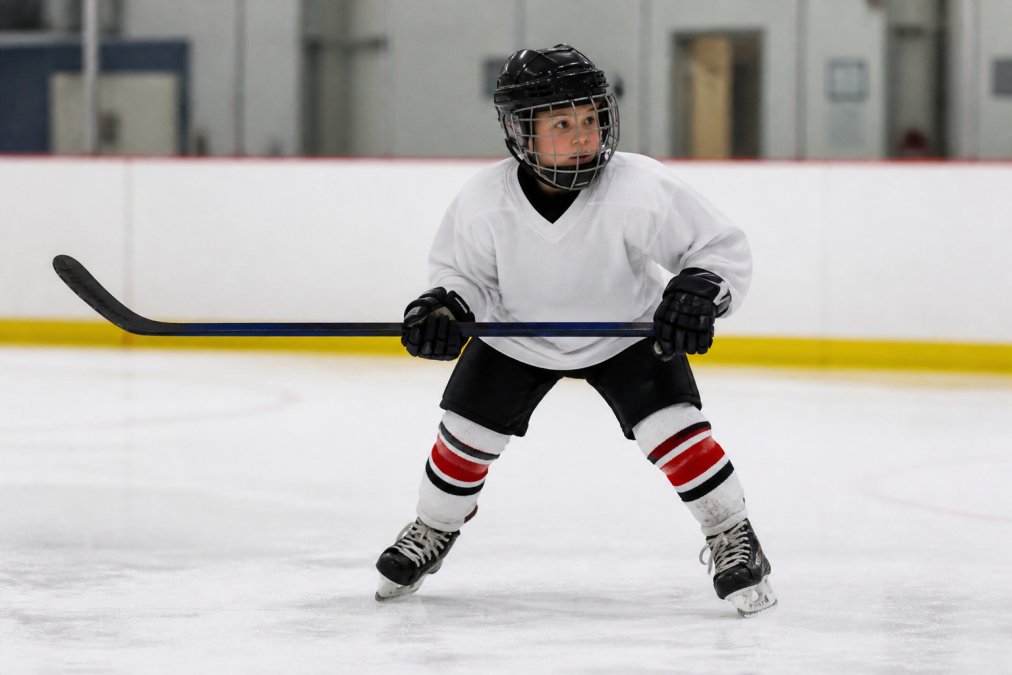
The hockey stance is a low, athletic position with knees bent, back straight, weight on the balls of your feet, and stick in front touching the ice. Bend your knees more than feels natural, your thighs should be almost parallel to the ice for power, balance, and control.
Forward and Backward Movement
Forward skating requires a smooth push-and-glide pattern. Push hard with one leg while gliding on the other, then alternate. The push comes from your hip and leg, not just your ankle. Take longer, more powerful pushes and glide longer between them, this is faster and uses less energy than tiny steps.
Steps to improve forward and backward movement:
- Push hard with one leg while gliding on the other
- Glide as long as possible before pushing again
- Alternate legs in a steady rhythm
- Keep your knees bent throughout
- Look ahead (forward) or over your shoulder (backward)
- Practice in a straight line before adding turns
Stopping and Turning Techniques
A hockey stop uses both skates to create friction. Turn your hips perpendicular to your direction of travel and dig both inside edges into the ice. Practice stopping in both directions equally well.
Hockey Positioning for Beginners
Hockey positioning means being in the right place at the right time to help your team. Don't chase the puck; anticipate where it will be and move to support your teammates. This is the biggest difference between recreational and competitive players.
Understanding Offensive Positions
The center plays in the middle, handling the puck and playing both offense and defense. Wings play on the sides, supporting the center and defending their side. When your team has the puck, forwards move to open ice, create passing lanes, and avoid crowding each other.
Offensive positioning basics:
- Spread out across the ice (don't bunch together)
- Move to open ice (away from defenders)
- Support the puck carrier (be ready for a pass)
- Get to scoring areas (near the goal)
- Move quickly between plays
Defensive Positioning and Coverage
Defensive positioning means staying between your opponent and the goal. Use zone defense, where each player covers a zone rather than following one opponent all over the ice. Zone defense is simpler and more effective for youth hockey than man-to-man defense.
Defensive positioning checklist:
- Stay between your opponent and the goal
- Keep your stick on the ice (block passes)
- Face the puck carrier (don't turn your back)
- Move your feet (don't stand still)
- Communicate with teammates (call out coverage)
Core Hockey Skills to Master
These three skills separate beginners from players who improve quickly. Practice these daily. They're the foundation for everything else.
Puck Control and Stickhandling
Stickhandling is moving the puck with your stick while skating. Hold your stick with your top hand near the blade and bottom hand lower on the shaft, about 12 inches apart. Move the puck side to side with small, quick touches, don't swing hard. Keep your hands relaxed; tension slows you down.
Stickhandling drills:
- Figure-eight patterns around cones
- Side-to-side movement in a straight line
- Stickhandling while skating forward and backward
- Stickhandling while turning
Passing and Receiving
A hockey pass uses a push motion, not a throwing motion. Pass accuracy matters more than speed, aim for your teammate's stick, not their body. To receive a pass, position your stick blade on the ice and give slightly as the puck arrives to cushion it. Don't stab at the puck; let it come to you.
Passing fundamentals:
- Push the puck, don't throw it
- Aim for your teammate's stick
- Pass ahead of a moving teammate (lead pass)
- Receive with a soft touch
- Keep your stick on the ice
Shooting Techniques
A wrist shot is the most common shot for beginners. Load the puck on your stick blade, bend your knees, and push the puck forward while rolling your wrists. The wrist shot is accurate, quick, and doesn't require a big backswing, perfect for close-range shooting. Focus on the wrist shot before attempting snap shots or slap shots.
Shooting tips:
- Keep your head up (see the goalie)
- Follow through toward the target
- Shoot low (harder to stop than high shots)
- Practice from different angles
- Shoot often (build muscle memory)
Off-Ice Training to Accelerate Progress
Off-ice training builds strength, speed, and endurance while preventing injuries and improving on-ice performance. Spend 2-3 sessions per week on off-ice training.
Strength and Conditioning Exercises
Leg strength is most important, squats, lunges, and step-ups power every move on ice. Core strength (planks, dead bugs, bird dogs) keeps you balanced and prevents injuries. Upper body strength (push-ups, pull-ups, rows) helps with shooting and passing. Bodyweight exercises work well.
Off-ice strength routine:
- Squats: 3 sets of 10-15 reps
- Lunges: 3 sets of 10 reps per leg
- Planks: 3 sets of 30-60 seconds
- Push-ups: 3 sets of 10-15 reps
- Pull-ups or rows: 3 sets of 8-12 reps
Flexibility and Injury Prevention
Stretch after every workout for 20-30 seconds, focusing on hips, hamstrings, quads, and shoulders. Yoga builds flexibility and balance. Always warm up before skating and cool down after to prevent muscle soreness and injury.
Flexibility routine:
- Hip flexor stretch: 30 seconds each side
- Hamstring stretch: 30 seconds each side
- Quad stretch: 30 seconds each side
- Shoulder stretch: 30 seconds each side
- Child's pose: 30-60 seconds
Getting Started: Registration and First Steps
You're ready to start. Now comes finding the right program and taking your first steps.
Finding a Beginner Program
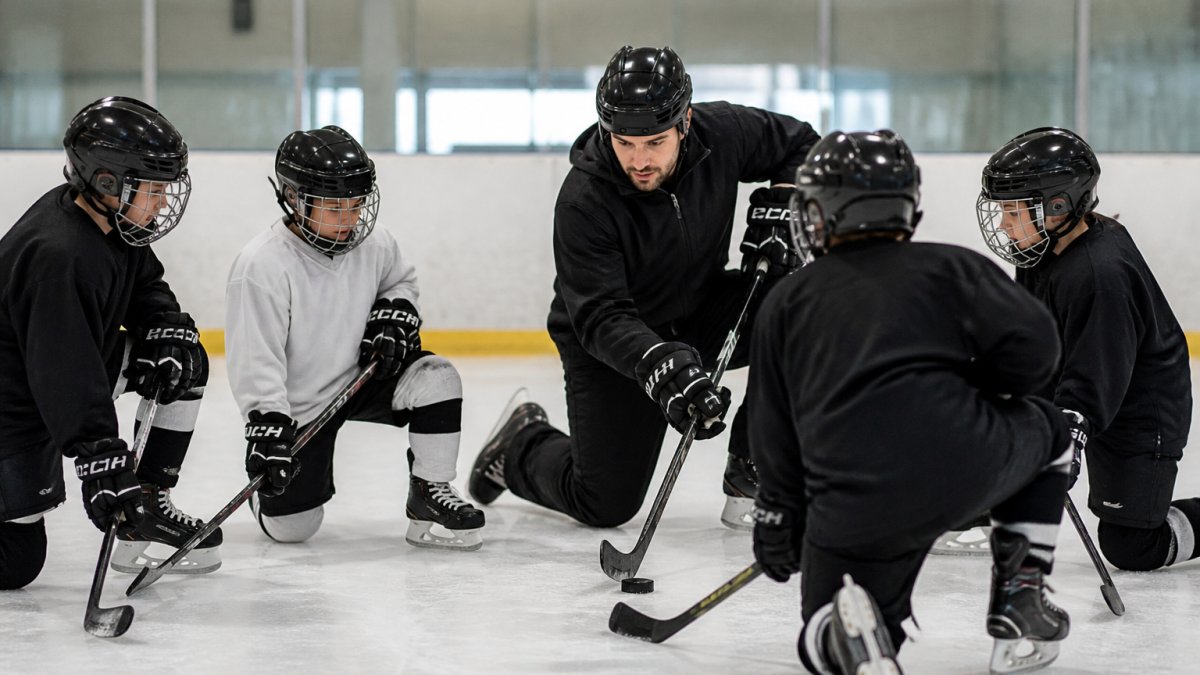
Check your local ice arena or recreation department for beginner programs. Look for a program with certified coaches who teach proper technique and prevent bad habits. Ask about sessions per week, session length, and costs. Visit the rink before enrolling to observe the coaches and atmosphere.
Questions to ask about programs:
- Are coaches certified?
- How many sessions per week?
- How long is each session?
- What's the cost?
- What equipment is required?
- What's the age range?
- Is there a trial session?
What to Expect in Your First Sessions
Your first sessions focus on skating and basic stick handling. Expect to feel awkward and have sore legs, this is normal and passes quickly. Bring water, snacks, and extra clothes. Arrive early and leave time to dry off. Make friends with other beginners and ask questions.
First session checklist:
- Arrive 15 minutes early
- Bring water and snacks
- Bring extra clothes
- Wear all protective equipment
- Ask questions
- Be patient with yourself
Common Mistakes to Avoid
Most beginners make the same mistakes. Knowing these mistakes helps you avoid them.
Frequently Asked Questions
Is it too late to learn to play hockey as an adult?
No. Adult recreational hockey programs are widespread and welcoming to beginners of all ages. Many adults start in their 20s, 30s, or beyond. You don't need prior skating experience, beginner programs teach skating fundamentals alongside hockey basics. The key is consistent ice time and patience with your progression.
What equipment do I need to start learning hockey?
At minimum, you need a hockey helmet with cage, skates, stick, gloves, shin guards, elbow pads, shoulder pads, and a mouthguard. Wear layers underneath, a hockey jersey or moisture-wicking shirt, hockey pants, and socks designed for hockey. Skate sharpening is essential for edge control on ice. Many beginners rent gear initially before investing in their own. A complete adult hockey gear checklist should include all protective equipment to prevent injury during falls and contact.
How long does it take to learn the basics of hockey?
Progress depends on your starting skating ability, frequency of practice, and quality coaching. Stickhandling and shooting accuracy improve over months and years. Progress depends on your starting skating ability, frequency of practice, and quality coaching. Beginners who combine on-ice training with off-ice conditioning often advance faster.
Do I need to know how to skate before learning hockey?
You don't need advanced skating ability, but basic comfort on ice helps. Most beginner hockey programs teach skating fundamentals as part of the curriculum. If you're nervous on skates, consider a few public skating sessions first to build confidence. Learning to skate for hockey is slightly different from recreational skating, hockey skating emphasizes edge control, quick stops, and explosive starts. Beginner programs account for varying skating levels and progress at a manageable pace.