 ultimate-guide
Hockey Positional Play for Adult Rec Leagues Guide
Last Updated: October 29, 2026
Quick Summary
Positional play is the shared structure that tells each player on a hockey team what job to do and where to be as the puck moves. In adult rec leagues it helps players make clean decisions without waiting for a coach's signal, and it often separates a team that chases the puck from one that holds its shape.
- Each skater has a distinct job in each of the three zones, not just defend or score.
- Strong-side defencemen pressure the puck carrier and become the first breakout option.
- Keep goal-side of your check; a recovered position beats a desperate stick check.
- Use short, role-specific calls like "man on" and "switch" to prevent double coverage.
- Practise a ten-minute 3-on-3 coverage drill once a week to build habits.
Table of Contents
- Why Positional Play Matters in Adult Rec Hockey
- Hockey Positions and Responsibilities on the Ice
- Forward Positioning in Hockey: Spacing, Support and Shape
- Hockey Breakout Positioning: Moving the Puck Out of Your Zone
- Hockey Defensive Zone Coverage and Team Communication
- Practice Drills and Game-Day Checklist for Adult Players
- Start Building Your Positional Sense Before Your Next Shift
- Frequently Asked Questions
Hockey Positional Play for Adult Rec Leagues Guide
Adult rec hockey is a different game from youth hockey, and most players who came up through structured programs learned positioning as a sequence of instructions rather than as a sense of space. Positional play can be learned visually, and this guide applies that logic to adult beginners who are trying to understand where to be on the ice. Positional play is the shared structure that tells each player what job to do and where to be when the puck moves, and in a recreational league it is often the difference between a team that chases and a team that holds shape.
Why Positional Play Matters in Adult Rec Hockey
Adult rec teams rarely have the same practice time as competitive leagues, so positional structure has to do more of the work on game day. A player who knows his lane can make a clean decision without waiting for a coach's signal.
Watch out: a new player who abandons his zone to chase the puck usually leaves a teammate exposed behind him, so the chase costs more than it gains.
Hockey Positions and Responsibilities on the Ice
Most rec-league guides stop at "defencemen defend, forwards score." That is not enough to play positionally. Each of the five skaters, plus the goalie, has a distinct job in each of the three zones, and those jobs change depending on whether your team has the puck or does not. The breakdown below covers all six roles so a new player can learn his responsibilities before his first shift.
Goalkeeper: the sixth skater in the structure
A rec-league goalie is not just a shot-stopper. He is the last line of the defensive structure and the first passer on the breakout. Key responsibilities:
- Angle and depth: Stay square to the puck carrier and adjust depth based on whether the shot is coming from the point or the slot. Too deep and you give up the top corners; too aggressive and you get beaten by a pass across the crease.
- Communication: Call out screens, backdoor attackers, and loose pucks. A goalie who calls "screen" or "backdoor" prevents goals that defenders never see coming.
- Puck handling: On dump-ins and rim-arounds, the goalie should stop the puck behind the net and make a simple first pass to the strong-side defenceman or wall forward. Do not force a stretch pass.
Defencemen: two distinct jobs
- Strong-side (puck-side) defenceman: Pressure the puck carrier, keep him to the outside, and stay goal-side. When your team gains possession, become the first breakout option, open your body to the boards and look for the wall forward.
- Weak-side defenceman: Protect the front of the net and the backdoor. Do not chase the puck to the strong side; hold the slot and communicate with the goalie about attackers sneaking in behind.
In the offensive zone, both defencemen should hold the blue line as passing options and step into the play only when the puck is securely possessed. A defenceman who pinches at the wrong moment gives up an odd-man rush the other way.
Centres: the link between defence and attack
A centre's job is the most demanding in rec hockey because it spans all three zones:
- Defensive zone: Support the defencemen on the breakout by dropping low as an outlet, and cover the high slot when the puck is below the goal line.
- Neutral zone: Be the first forward back on defence and the first forward supporting the puck carrier through the middle. The centre is usually the player who decides whether the team transitions cleanly or turns the puck over at the blue line.
- Offensive zone: Provide low support below the goal line, cycle the puck, and cover for a pinching defenceman by staying high in the slot.
Wingers: spacing and support on both sides
- Strong-side winger: Provide a wall outlet on the breakout, then drive up the boards as a passing option. In the offensive zone, get to the front of the net or the corner, depending on the cycle.
- Weak-side winger: Stay high and wide as the safety valve. When the puck turns over, the weak-side winger is often the first player back, so do not get caught deep in the offensive zone.
Attacking shape: what positions look like with the puck
Positioning is not only defensive. When your team has possession, the five skaters should form a shape that creates passing options and covers for turnovers:
- Spread the ice: Forwards should occupy three different lanes (left, centre, right) rather than clustering. A bunched group has no passing angles.
- Support distance: Stay within a short pass of the puck carrier, close enough to receive, far enough to avoid an immediate check.
- One player high: On every attack, one player (usually a defenceman or the high centre) stays above the puck as a safety valve. If the puck turns over, that player is the first line of defence.
Transitions: the moment positions change
The most common rec-league breakdown happens in the two seconds after a turnover. When your team loses the puck in the offensive zone, the nearest player pressures the puck carrier while the other four retreat to their defensive lanes. When your team wins the puck in your own zone, the defenceman looks up-ice first, then to the wall, then to the centre as a low outlet.
Each skater has a distinct job in each zone, and the article's breakdown of responsibilities can be summarised like this:
| Position | Primary responsibility | Key point |
|---|---|---|
| Goalkeeper | Angle and depth, calling screens and backdoors | Stop the puck behind the net, simple first pass |
| Strong-side defenceman | Pressure puck carrier, keep goal-side | First breakout option to the wall forward |
| Weak-side defenceman | Protect the front of the net and backdoor | Hold the slot, do not chase to strong side |
| Centre | Link defence and attack across all zones | Low outlet on breakout, first back in neutral zone |
| Strong-side winger | Wall outlet on breakout, drive up the boards | Get to front of net or corner on cycle |
| Weak-side winger | Stay high and wide as safety valve | First player back after a turnover |
Forward Positioning in Hockey: Spacing, Support and Shape
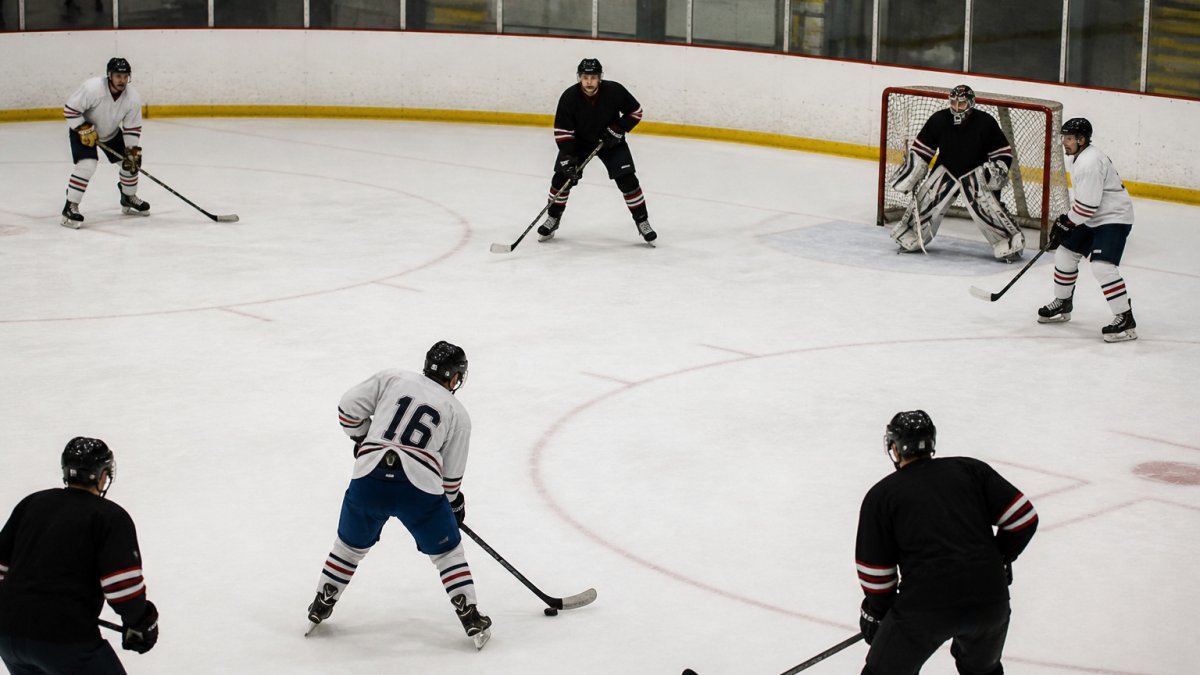
Spacing is what gives a forward line its shape. Three forwards spread across the offensive zone create passing angles that a bunched group cannot. Support means staying within a short distance of the puck carrier, close enough to receive a pass but far enough to avoid an immediate check. Shape is the pattern the group holds over time, and it is easier to maintain when every player knows his lane.
Hockey Breakout Positioning: Moving the Puck Out of Your Zone
The breakout is where positional play is tested most often. The defenceman with the puck looks for the nearest wing on the boards; the centre drops to provide an outlet; the far-side forward releases toward the neutral zone as a potential target. Teams that practise the breakout as a sequence tend to make cleaner exits, and the pattern is simple enough for adult players to learn quickly.
Hockey Defensive Zone Coverage and Team Communication
Defensive zone coverage in adult rec hockey fails for predictable reasons: players ball-watch, two defenders chase the same puck carrier, and nobody picks up the late forward entering the slot. The fix is not more skating, it is assigning coverage responsibilities before the puck enters your zone and using short, consistent calls so everyone knows who has whom.
The three coverage assignments you actually need
Most rec teams run one of three coverages. Pick one, practise it, and stick with it long enough for players to learn their reads.
- Man-on-man: Each defender or forward is responsible for one opponent. Simple to teach, but it breaks down when a player gets beaten or when the opposition runs picks and switches. Best for teams with similar skating ability across the roster.
- Zone coverage: Players cover areas (slot, front of net, wall, point) rather than specific opponents. More forgiving when players are mismatched, but it requires players to hand off attackers as they cross zones, and handoffs are where rec teams get burned.
- Hybrid (box-plus-one): The four players without the puck form a box in front of the net while one forward pressures the puck carrier. This is the most common rec-league compromise: it protects the slot, keeps a player on the puck, and does not demand perfect man-on-man discipline.
Goal-side positioning: the non-negotiable
Whatever coverage you choose, the first principle is the same: stay goal-side of your check. That means your body is between your opponent and your own net, even when you are skating backwards. A defender who gets caught puck-side, body between the attacker and the boards rather than the net, has already lost the race. In practice, this means taking an angle on the attacker's inside shoulder rather than chasing him to the outside.
Specific calls that prevent double coverage
Vague communication ("I've got him") causes collisions and open opponents. Use short, role-specific calls:
- "Man on", I am taking the puck carrier; do not step to him.
- "I've got the wall", I am covering the opponent on the boards; you take the slot.
- "Switch", we are trading assignments because of a pick or a crossing attacker.
Assign one player, usually the centre or the most vocal defender, as the caller. In rec leagues, one clear voice beats five players shouting different instructions.
Common rec-league coverage mistakes and fixes
- Two players chasing the puck carrier. Fix: the nearest player pressures; everyone else holds their zone and finds the open opponent.
- Losing the late forward in the slot. Fix: assign one player (often the weak-side winger) to watch the high slot and call out any late attacker.
- Defenders standing still at the point. Fix: the point defender should stay mobile and keep a stick in the passing lane, not plant feet.
Practising coverage in ten minutes
Run a simple 3-on-3 down-low drill: three attackers cycle the puck below the goal line while three defenders practise staying goal-side, calling switches, and boxing out the slot. Rotate a fourth defender in every 90 seconds. Ten minutes of this once a week builds the habits that prevent the most common rec-league breakdowns.
Practice Drills and Game-Day Checklist for Adult Players
Short, repeatable drills suit adult schedules. Run a three-on-two breakout drill for ten minutes, then rotate players through their positions so each person experiences the other roles. Before each game, confirm the following:
- Know your primary lane and your backup position
- Agree on who calls the breakout
- Identify the opponent you are responsible for in each zone
For players who want to study positions away from the rink, Hockey Positioning™ is an interactive mobile app with an interactive ice surface where you can drag the puck and see players move to their positions. It is designed for players aged 5 to 13 and for adults new to the sport, and it includes coaching tips at each puck location.
Start Building Your Positional Sense Before Your Next Shift
Positional sense develops through repetition, not one clinic or one video. Pick one position, run one drill this week, and track whether your teammates know where you are. Download Hockey Positioning™ on the App Store to practise the scenarios that matter for your role.
Frequently Asked Questions
Can I learn ice hockey as an adult?
Yes. Many adults start hockey in recreational leagues with no prior experience, and most rec leagues accept new players at beginner skill levels. The fastest way to improve is to learn where you should be on the ice in each situation, not only how to skate and handle the stick. Learning positional play early keeps you from chasing the puck, lets you contribute without a high skill level, and makes games more enjoyable. Start with the basic responsibilities for your position, then practise staying in your zone and supporting teammates.
Where should forwards position themselves in adult recreational hockey?
In adult rec hockey, forwards should spread out to create passing lanes rather than cluster around the puck. One forward usually stays high for a pass out of the zone, while the other supports the puck carrier at a distance that gives them a pass option. When your team loses the puck, move back toward the centre of the ice and get between the puck and your own net. Keeping spacing consistent is the main habit to build, and it matters more than any single fancy move.
How should defencemen position themselves in a rec league game?
Defencemen should generally stay goal-side of the opponent they are marking, meaning between that player and the net. Keep your stick active to take away passing lanes, and avoid lunging at the puck, which often opens space behind you. Work with your partner so one defender pressures the puck while the other covers the closest threat. In the defensive zone, your job is to protect the slot and clear rebounds, not to chase every loose puck to the boards.
How can adult beginners improve their hockey positioning?
Adult beginners improve positioning by learning a few simple rules and repeating them in every shift. Know your assigned role for each situation, keep your head up to read where teammates and opponents are, and aim to be in a spot that gives your team a passing option. Watching a game from the bench helps you see how good players space themselves. Ask a teammate or coach to point out one positioning mistake after each game and focus on fixing that single issue before the next one.
What should players do when their team loses possession?
When your team loses possession, the first priority is to get goal-side of the nearest opponent and reduce their options. Forwards should retreat toward the centre of the ice, and defencemen should move to protect the middle of the defensive zone. Communicate clearly with teammates so everyone knows who is marking whom. Quick recovery matters more than winning the puck back immediately, because a disciplined shape gives your team time to regroup and force a bad shot or turnover.