 ultimate-guide
The Beginner's Guide to Hockey Positional Play
Quick Summary
Hockey positional play is a system where each player owns an area of the ice and supports teammates instead of chasing the puck. Players learn where to be, which keeps the ice from opening up behind a swarm and lets the team move as a unit.
- Chasing the puck leaves open space behind players that opponents use for passes and shots.
- Stay between the puck and your own net when defending.
- In the neutral zone, stay about two stick-lengths from your nearest teammate.
- When you lose the puck in the neutral zone, pressure immediately and retreat through the middle of the ice.
- Try at least two positions in practice before picking a primary position.
Table of Contents
- Why Hockey Positional Play Matters More Than Chasing the Puck
- Ice Hockey Positions and Roles: The Six Players on the Ice
- Hockey Offensive Zone Positioning: Where to Move When You Attack
- Basic Hockey Defensive Positioning: Staying Between the Puck and the Net
- Neutral Zone Positioning, Transitions and Spacing with Teammates
- How to Choose a Hockey Position as a Beginner
- Common Beginner Mistakes and Practice Steps for Your Next Game
- Frequently Asked Questions
The Beginner's Guide to Hockey Positional Play
Last Updated: November 1, 2026
Why Hockey Positional Play Matters More Than Chasing the Puck
Hockey positional play for beginners is the difference between skating around the puck and actually helping your team win. Most new players chase the puck because it is the most visible thing on the ice.
Chasing the puck creates predictable problems: when everyone swarms the puck, the ice opens up behind them and opponents find space for passes and shots.
Ice Hockey Positions and Roles: The Six Players on the Ice
A standard hockey lineup includes six skaters on the ice at once, plus a goaltender. For more context on how these roles work in a recreational league setting, see the same-topic guide. Each position has its own job, but the roles overlap, and good teams rely on constant communication.
Goaltender, Defensemen and Centers
The goaltender stops the puck from entering the net, tracking shots, controlling rebounds, and communicating with defensemen about coverage. Goalies rarely leave the crease except to play the puck behind the net or challenge an attacker.
Defensemen, usually two at a time, protect the area in front of the goaltender.
Centers are the most versatile forwards. They take faceoffs, help in both zones, and often link defensive and offensive play.
Left Wing and Right Wing
Wingers play on either side of the center and focus on scoring and creating chances in the offensive zone.
Wingers also have defensive duties. When the opposition has the puck, they must back-check toward their own zone to cover opponents and reinforce the defensive structure. Beginners often forget this, leaving their team vulnerable on counterattacks. Try these beginner positioning drills before your next game.
Hockey Offensive Zone Positioning: Where to Move When You Attack
Hockey offensive zone positioning is about creating space and keeping passing options open.
Think in triangles: keep players spread so the puck carrier always has at least two options, one pass forward and one to the side or back. Wingers hold wide positions to stretch the defense, while the center often works the middle near the top of the circles.
Beginners often bunch together around the puck in the offensive zone, which lets the defense collapse on one spot. Move away from the puck, not toward it, so the opponent has to choose where to defend.
Positioning also changes with the puck. When a teammate has it along the boards, be open for a pass or screen the goaltender's view.
Basic Hockey Defensive Positioning: Staying Between the Puck and the Net
Defensive positioning follows a central principle: stay between the puck and your own net.
When an opponent carries the puck toward your zone, close the gap and take away their options.
Defensive play also depends on support. A defenseman who lunges at an attacker without backup often gets beaten.
Many beginners ask which opponent to cover. Stay closest to the player most dangerous to score while still watching the puck; if the puck is far away and an opponent is open near the net, that player takes priority.
Neutral Zone Positioning, Transitions and Spacing with Teammates
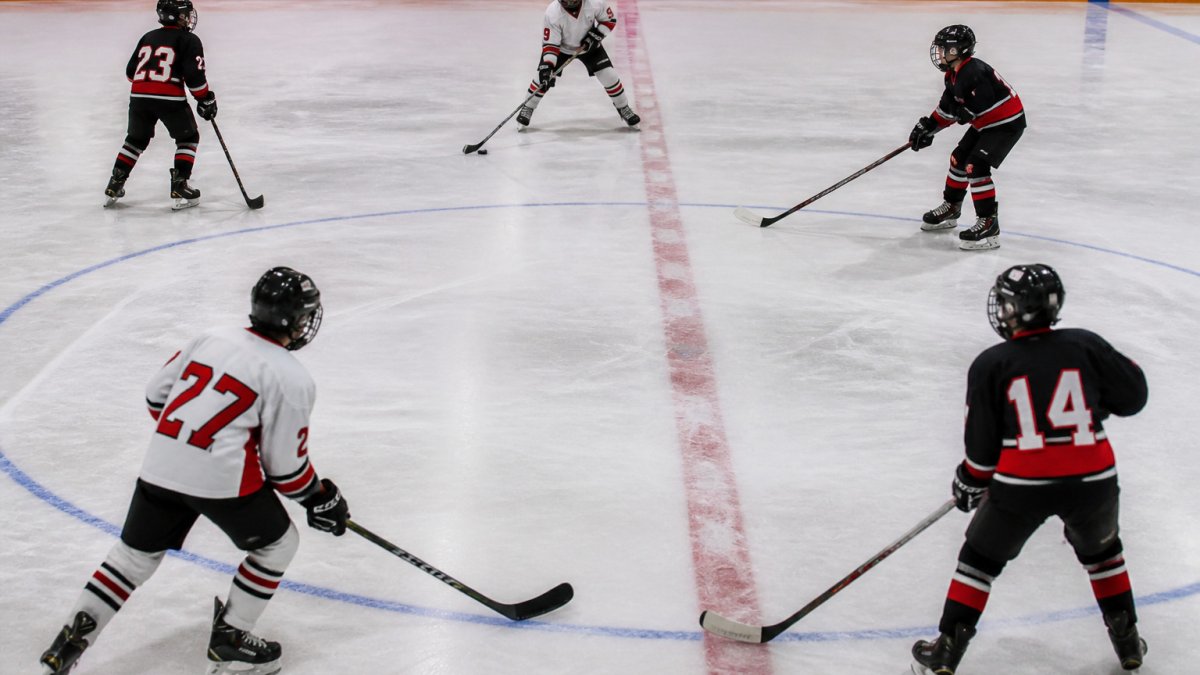
The neutral zone is the middle third of the rink, between the two blue lines, and it is where many games are decided because it is the transition area. For beginners, it is the hardest area to read because there is no net directly in front of you and no boards to guide you. Learn a few simple rules for spacing, scanning, and communication so you are never caught flat-footed when the puck changes hands.
Spacing: The Passing-Lane Rule
Spacing in the neutral zone is not about standing a fixed distance apart. It is about staying in a passing lane while keeping enough separation that one defender cannot cover two of you.
Think in triangles rather than lines. On a breakout, the puck carrier should have one support option ahead and one to the side, creating a triangle that is hard for a single defender to break up.
Scanning: What to Look For Before You Move
Beginners often move after the puck moves. Better players scan before the puck arrives. In the neutral zone, scan for three things in this order:
- Where is the puck? Is it on your team's stick, in a battle, or on an opponent's stick?
- Where is the nearest opponent? Are they pressuring you, or are they backing off?
- Where is your support? Is a teammate open ahead of you, beside you, or behind you?
A simple habit is the shoulder check every three to five seconds. Turn your head so you can see the puck and the nearest opponent at the same time; if you cannot see both, adjust your body angle until you can. This is the same principle defensemen use when they angle attackers toward the boards.
Communication: Short, Loud, Specific
The neutral zone is noisy, so calls must be short and specific. Useful beginner calls include:
- "Wide!", you are open on the wing.
- "Middle!", you are open in the center lane.
- "Support!", you are behind the puck carrier as a safe outlet.
Avoid vague calls like "Here!" or "Pass!" because they do not tell the carrier where you are or whether it is safe. Point with your stick as well as calling, especially when the rink is loud.
Transitions: The Five-Second Rule
When your team loses the puck in the neutral zone, the first five seconds decide whether the opponent gets an odd-man rush. The nearest player should pressure immediately, even just to slow the opponent down. The next nearest should retreat through the middle of the ice, not along the boards, to cover the most dangerous passing lane. The rest back-check toward their own zone while keeping their spacing.
When your team wins the puck in the neutral zone, the first look should be forward. If a teammate is ahead and open, move the puck up immediately; if not, use the support behind you to reset and keep possession. Beginners often force a long pass through traffic when a short, safe pass to a supporting teammate is the better choice.
Faceoffs and Odd-Man Rushes
In the neutral zone, faceoffs are a set play. Ask your coach for your team's faceoff alignment, but a common beginner setup is for the center to take the draw, the wings to line up wide on their respective sides, and the defensemen to stay back near the blue line.
On an odd-man rush, for example, a two-on-one, the puck carrier should drive toward the defender to force a decision, while the supporting player stays wide and slightly behind so they can receive a pass or pick up a rebound.
How to Choose a Hockey Position as a Beginner
Choosing a position as a beginner is less about finding your perfect role and more about discovering where your skills and comfort fit. A structured guide to learning the position roles can help you compare them faster. Most young players start at one position and later move to another, and that flexibility is valuable. The right starting position depends heavily on your age, your skill level, and the format you are playing, a six-year-old in a cross-ice program has different needs than a fourteen-year-old in full-ice travel hockey, and a beginner adult in a recreational league has different needs again.
Start With a Self-Assessment
Before you pick a position, answer these questions honestly:
- How strong is your skating? Fast, agile skaters often do well as wingers or centers, where quick changes of direction matter. Players who are still building skating confidence often do better on defense, where you can see the play develop in front of you.
- How comfortable are you with physical contact? Defensemen absorb hits and block shots, so players who enjoy physical contact often thrive there. In non-checking leagues, this matters less, but blocking shots and battling in front of the net still require comfort with contact.
- How well do you scan the ice? Centers need to see the whole ice, so players who read the play well are often suited to that role. If you find yourself watching the puck too much, wing may be a better starting point because your responsibilities are more contained.
- What is your stamina like? Centers and wingers skate more continuous shifts, while defensemen often have shorter, more explosive shifts. Beginners who tire quickly may prefer defense at first.
- What does your coach need? In beginner hockey, team needs often matter more than personal preference. A coach may ask you to try a position because the team is short there, and that experience is valuable even if it is not your first choice.
Adjust by Age and Skill Level
Young beginners (roughly ages 5-9): In many minor hockey programs, players rotate through all positions during their early years. This is deliberate.
Pre-teen and teen beginners (roughly ages 10-14): Players at this stage often start to show preferences and strengths. A good approach is to pick one primary position and one secondary position.
Adult beginners: Adult recreational leagues often have players who are new to hockey but have played other sports.
Adjust by Game Format
Cross-ice and half-ice formats: In many youth programs, beginners start on cross-ice or half-ice surfaces. In these formats, positions are less rigid. The goal is to get touches on the puck and learn to move without the puck.
Full-ice 5-on-5: This is where positional roles become more defined. Beginners in full-ice games should focus on the basics: wings stay wide, centers support the middle, defensemen stay between the puck and the net, and everyone back-checks.
3-on-3 and 4-on-4: These formats are common in youth development and recreational leagues. They create more space and more puck touches, which is great for beginners. In 3-on-3, roles blur: everyone must be able to play both offense and defense. This is an excellent format for beginners because it forces you to learn transition play.
Common Beginner Mistakes in Position Selection
- Picking a position based only on scoring. Beginners often want to be a center or winger because those positions score more goals. But defense is a great place to learn the game because you see the whole ice and learn to read plays. Many strong forwards started as defensemen.
- Refusing to try other positions. Flexibility is a strength. A player who can play wing and defense is more valuable to a beginner team than a player who only plays one position.
- Choosing based on a single game. One bad game at defense does not mean you are a bad defenseman. Give a new position several practices and games before deciding.
A Simple Decision Process
Here is a practical process you can use over your first season:
- Try at least two positions in practice. Ask your coach to rotate you through different roles so you can compare how each one feels.
- Pick one primary position after four to six weeks. Give it enough time to feel normal.
- Keep one secondary position. This makes you more useful to your team and helps you understand the game from another angle.
- Ask for feedback. Coaches and teammates can point out strengths you may not notice yourself.
- Reassess at the end of the season. Your skills will change, and your best position may change with them.
Remember that positional play is a team concept. Even if you have a favorite position, understanding the other five roles makes you a better teammate and helps you anticipate how the game will unfold.
Common Beginner Mistakes and Practice Steps for Your Next Game
Most beginners make the same handful of mistakes, and fixing them quickly makes a visible difference.
| Mistake | Why It Hurts | Practice Step |
|---|---|---|
| Chasing the puck in a pack | Leaves open space for opponents | Hold your zone; move only when the puck enters your area |
| Skating past your position | Creates gaps and odd-man rushes | Visualize your zone boundaries during warm-ups |
| Forgetting to back-check | Leaves teammates outnumbered | Practice skating back to defense immediately after losing the puck |
| Standing still in the neutral zone | Allows opponents to trap the puck | Keep moving to offer a passing angle |
| Ignoring teammates | Disrupts spacing and coverage | Call for the puck and announce your position |
To practice these skills, try a simple drill at your next practice: set up cones to mark three zones on half the ice, then have players move through the zones while the coach calls out puck locations. Each time the coach calls a new puck location, players must move to their correct positions. Repeat the drill several times, then ask players to explain where they went and why.
Measurable learning goals help too. Aim to complete three full shifts without chasing the puck, or to recover from a turnover within five seconds.
Hockey Positioning™ is an interactive mobile app where you drag the puck across a full interactive ice surface and see players move to their correct positions for game scenarios.
Frequently Asked Questions
What are the positions in ice hockey?
A hockey team fields six players at a time on the ice: a goaltender, two defensemen, a center, a left wing and a right wing. The goaltender guards the net. The two defensemen usually stay farther back and defend the blue line area. The center and two wings make up the forward group, with the center often taking faceoffs and the wings playing on either side of the ice. Youth leagues sometimes adjust rules and roster sizes, so check your league's guidelines, but the core positions stay the same across most levels of play.
What does each hockey position do?
Each position has a primary job. The goaltender stops shots and directs the defense. Defensemen prevent the opposing team from getting clean shots near the net and start breakouts. The center plays both ends of the ice, handles most faceoffs and supports both the offense and defense. Wingers spread the play across the width of the rink, create passing lanes and finish scoring chances. Positional play means understanding these roles and moving to the spot that supports the teammates around you.
Where should a beginner play on the ice?
Most beginners do best starting as a winger or a defenseman, because these roles give clear spots to hold while the puck moves. Focus on staying in your lane, keeping your body between the puck carrier and the net, and maintaining space from your teammates. Learn to move to the open area rather than following the puck into a crowd. As your skating and reading of the game improve, you can try other roles with your coach's guidance.
How should hockey forwards position themselves in the offensive zone?
Forwards should spread out so the defense cannot cover everyone at once. Wingers usually hold the outside lanes near the boards, while the center takes a middle position closer to the net or the point. When your team has the puck, move toward open ice and be ready for a pass. If the puck is lost, shift back into a defensive shape quickly. Good offensive positioning is less about chasing the puck and more about creating a lane where a teammate can pass to you.
What does a defenseman do when their team has the puck?
When your team has the puck, a defenseman should move into open ice to support the breakout, usually staying near the blue line to be a safe passing option. Keep enough distance from teammates so you are not bunched together, and watch for the opponent's forwards who may try to pinch in and steal the puck. Once the puck crosses the blue line, move up in the rush only as much as your team needs, then be ready to return to defense if possession changes.
How do hockey players position themselves in the defensive zone?
In the defensive zone, players aim to stay between the opponent and the net while keeping an eye on the puck. Defensemen usually cover the front of the net and the most dangerous areas, while forwards help pick up open players and block passing lanes. Keep your stick on the ice to block passes and your body low and balanced. A simple habit is to check where the puck is, where your opponent is, and where the net is before every move.
How do I know which hockey position is right for me?
Start by considering your strengths. Players who skate fast and enjoy scoring often do well as wingers. Players who like reading the game and defending may prefer defense. Players who win battles at faceoffs and handle the puck in traffic often fit the center role. Your coach's evaluation at practice is also valuable, and many young players try several positions before settling on one. Try different roles during practice and ask your coach which area needs more development.
Positional play is a skill you build over time, one shift at a time. Start with the basics: know your zone, stay between the puck and the net, and support your teammates. Hockey Positioning™ can help you practice these ideas away from the rink, so you arrive at your next game ready to play with confidence.