 How-to
7 Drills That Will Make You Faster on Skates
Quick Summary
To improve hockey skating speed, fix your stride mechanics before adding more effort: take longer strides, push out and back through the inside edge, and keep your knees bent and chest over your toes. Pair this technique work with a few focused drills, like long-stride pushes and lateral pushes, and then build power off-ice.
- Finish each push fully instead of recovering the leg early.
- Push out and back through the inside edge, not straight down.
- Keep knees bent and chest over toes throughout every stride.
- Do three drills per session at full effort with full rest between reps.
- Test progress with a 30-metre sprint every four weeks, counting strides.
Table of Contents
- What Actually Limits Your Hockey Skating Speed
- Fixing Your Stride: Length, Width and Lateral Push
- Hockey Skating Speed Drills for On-Ice Practice
- How to Improve Hockey Skating Speed for Beginners: A Progressive Plan
- How to Improve Hockey Skating Speed at Home and Off-Ice
- How to Get Faster in Hockey Off-Ice: Strength, Power and Conditioning
- Testing Your Progress and Fixing Common Technique Errors
- Booking Your First Session to Build Positional Speed
- Frequently Asked Questions
What Actually Limits Your Hockey Skating Speed
Last Updated: November 22, 2026
Most players think they need to skate harder to go faster. They don't. Speed on skates depends on how efficiently you push, not only how hard you grind. The drills below are designed to fix the mechanics that slow players down.
Speed is usually limited by a few specific problems. The stride is too short. The push goes sideways instead of back. The upper body fights the legs.
- Short, choppy strides that never reach full extension
- A push that drifts forward instead of driving back
- Hips and shoulders that rotate against the direction of travel
- Weight stuck on the heels or toes instead of balanced over the blade
A common mistake is adding gym work before fixing the stride. Strength helps, but a weak stride wastes it. Start with technique, then build power on top of it.
Fixing Your Stride: Length, Width and Lateral Push
A good stride is long, wide enough to push against, and finished all the way through. Most beginners stop their push early and bring the leg back too soon. That cuts off the most powerful part of the stroke.
Think of the stride as three parts: the push, the glide, and the recovery. The push should drive the blade out to the side and back, pressing through the inside edge. The glide lets you carry that speed. The recovery brings the foot back under your body so you can push again.
Balance, Body Position and Weight Transfer
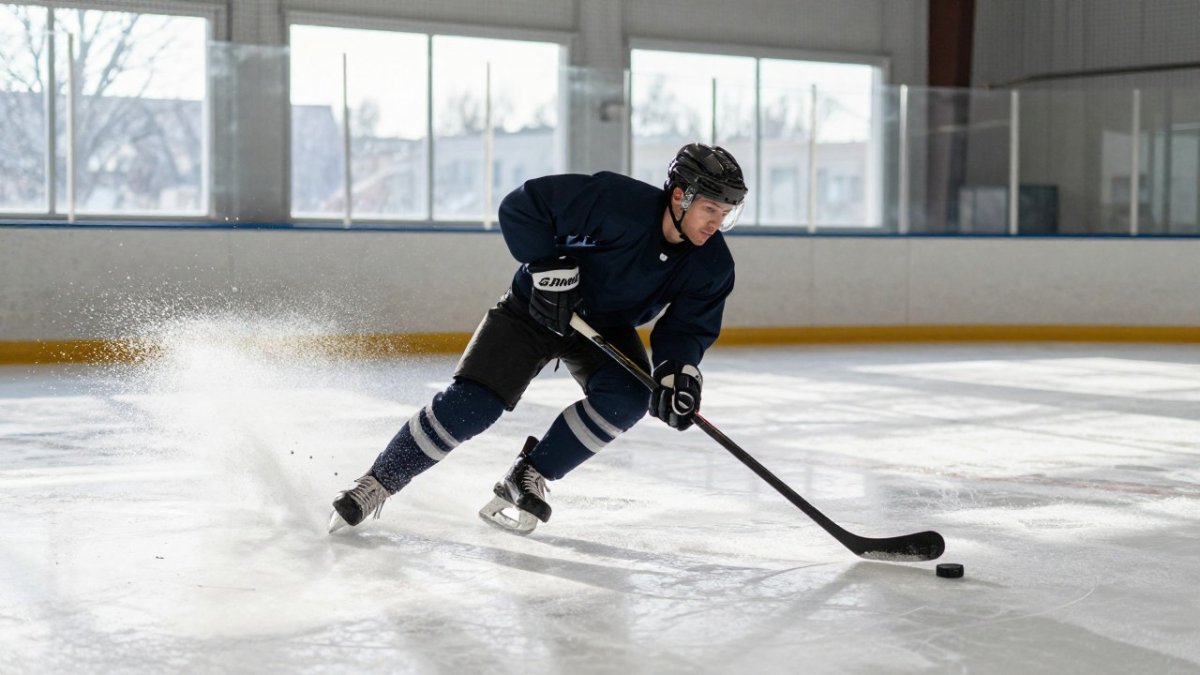
Your body position decides how much force reaches the ice. Keep your knees bent and your chest over your toes. Stand too tall and you lose power. Lean too far forward and you lose balance.
Weight transfer matters just as much. Shift your weight smoothly from one skate to the other on every stride. Players who stay on one leg too long look slow even when they are working hard.
Arm Swing and Torso Rotation
Your arms are not decoration. A relaxed, opposite arm swing helps your legs move in rhythm. Drive the elbow back on each push, and keep the hands low and in front of the body.
Torso rotation should stay quiet. Let the hips do the work, and keep the shoulders facing forward. Excess twisting costs you energy on every stride.
Hockey Skating Speed Drills for On-Ice Practice
Most drill lists stop at the name. What actually changes skating speed is the setup, the rep scheme, and the cue you focus on during each rep.
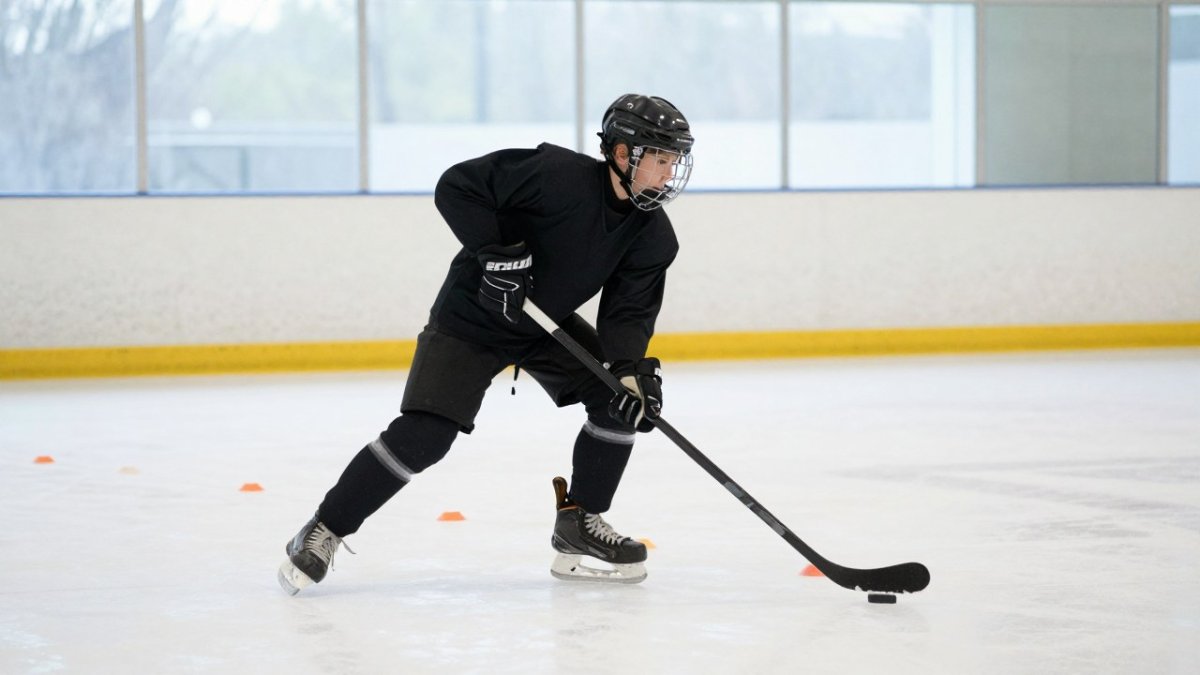
1. Long-stride pushes
- Setup: Full length of the ice, one skater at a time or in two lanes.
- Reps: 4 lengths, 45-60 seconds rest between lengths.
- Cue: "Finish the stride." Count your strides and try to take one fewer each length without slowing down.
2. Lateral push drill
- Setup: Blue line to blue line, working across the width of the rink.
- Reps: 6 crossings, 30 seconds rest.
- Cue: "Push out, not down." Press through the inside edge and let the blade travel sideways before recovery.
3. Edge control figure-eights
- Setup: Two faceoff circles, skate a figure-eight around both.
- Reps: 3 sets of 2 laps, 60 seconds rest.
- Cue: "Deep inside edge." Keep the knees bent and lean into the turn rather than standing up through it.
4. Tight-circle crossovers
- Setup: One faceoff circle, skate crossovers around it in both directions.
- Reps: 4 sets of 30 seconds, 45 seconds rest.
- Cue: "Wide and powerful." Reach the outside leg across and pull it back under the body.
5. Start-stop accelerations
- Setup: Goal line to blue line, from a standstill.
- Reps: 8 sprints of 5-8 strides, walk back to recover.
- Cue: "First three steps." Explode low and keep the chest over the toes for the first three pushes.
6. Cone weave sprints
- Setup: Four cones in a line, 3 metres apart.
- Reps: 6 runs through the cones, 45 seconds rest.
- Cue: "Stay low through the turn." Keep the hips down and push out of each turn rather than gliding through it.
7. Full-ice sprints
- Setup: Goal line to goal line.
- Reps: 6 sprints, 60-90 seconds rest.
- Cue: "Push length over speed." Focus on the length of each push, not on the clock.
Set cones at clear distances so you can measure progress. Coaches often add cues like "push back, not down" or "finish the stride" to keep focus on the mechanics.
The seven drills are easier to compare when the setup, reps, and cue for each are laid out side by side.
| Drill | Reps | Key cue |
|---|---|---|
| Long-stride pushes | 4 lengths, 45-60 s rest | Finish the stride |
| Lateral push drill | 6 crossings, 30 s rest | Push out, not down |
| Edge control figure-eights | 3 sets of 2 laps, 60 s rest | Deep inside edge |
| Tight-circle crossovers | 4 sets of 30 s, 45 s rest | Wide and powerful |
| Start-stop accelerations | 8 sprints of 5-8 strides | First three steps |
| Cone weave sprints | 6 runs, 45 s rest | Stay low through the turn |
| Full-ice sprints | 6 sprints, 60-90 s rest | Push length over speed |
How to Improve Hockey Skating Speed for Beginners: A Progressive Plan
Beginners should not jump straight into full-speed sprints. Build the skill in stages. Follow this plan for about six weeks, skating two or three times per week.
- Weeks 1 and 2: Focus on balance, a low body position, and slow, controlled pushes.
- Weeks 3 and 4: Add longer strides, lateral pushes, and edge control drills.
- Weeks 5 and 6: Introduce full-effort accelerations and sprints with rest between reps.
Progress only when your form holds. If your stride breaks down, slow down and fix it. Speed without form builds bad habits that are hard to undo later.
The Hockey Positioning™ app shows players where to be in each situation, which can complement skating work on the ice. For a structured walkthrough, see learning hockey positioning as an adult beginner.
How to Improve Hockey Skating Speed at Home and Off-Ice
You can build skating speed away from the rink. Off-ice work strengthens the muscles you use to push, and it does not require special equipment. A beginner's overview of hockey fundamentals covers skills you can practice away from the rink.
- Lateral lunges: Build the hip and inner thigh strength used in the lateral push.
- Single-leg squats: Improve balance and single-leg power.
- Skater jumps: Practice side-to-side hops to build explosive push-off.
- Wall sits: Train the knee-bent position you hold on the ice.
Two or three short sessions per week are enough for most players. Keep the work simple and consistent. For more ways to sharpen awareness without being on the ice, read improve hockey IQ at home.
How to Get Faster in Hockey Off-Ice: Strength, Power and Conditioning
Power comes from strength, and strength comes from consistent training. Focus on lower-body strength first, then add explosive movements.
Work on three areas:
- Strength: Squats, deadlifts and lunges, done with good form.
- Power: Box jumps and broad jumps for fast leg drive.
- Conditioning: Short sprints with full rest between efforts builds speed. Slow, long cardio alone does little for sprint power.
Recovery matters too. Muscles get stronger during rest, so do not train hard every day. Sleep well and take at least one full rest day each week to avoid overuse injuries.
Testing Your Progress and Fixing Common Technique Errors
Most players never measure whether their skating is actually getting faster. A simple, repeatable test removes the guesswork and tells you whether the drills are working.
The 30-metre sprint test
- Setup: Mark a start line and a finish line 30 metres apart on the ice. Use a phone timer or a partner with a stopwatch.
- Protocol: From a standing start, sprint the full 30 metres at full effort. Record the time and the number of strides.
- Reps: 3 trials with 2 minutes rest between each. Use your best time.
- Retest: Once every 4 weeks, same ice, same skates, same start position.
What the numbers tell you
- Faster time with the same stride count means your push is more powerful.
- Same time with fewer strides means your stride is longer and more efficient.
- Slower time with more strides means fatigue or a technique breakdown, check the errors below.
Common technique errors and how to fix them
- Short strides: You are recovering the leg before the push finishes. Fix: count strides on a full-length push and aim to take one fewer each rep.
- Pushing down instead of back: The blade goes straight down and the skate slips. Fix: think "out and back" and press through the inside edge.
- Standing too tall: The chest comes up and the knees straighten. Fix: keep the chest over the toes and the knees bent through the whole stride.
- Crossed skates: The recovery foot lands across the midline. Fix: keep the skates shoulder-width apart and bring the foot back under the hip.
- Mistimed arm swing: The arms move with the legs instead of opposite them. Fix: drive the elbow back on each push and keep the hands low and in front.
Film yourself from the side if you can. Video shows problems that you cannot feel while skating. You can also see how game-flow apps show what good play looks like. Watch out: do not change more than one technique cue at a time, if you fix everything at once, you will not know which change made the difference.
Booking Your First Session to Build Positional Speed
Speed matters most when it gets you to the right place at the right time. Start with the drills and plan above, then practice where you should be in real game situations.
Hockey Positioning™ is an interactive app that lets you drag the puck across a full ice surface and see where each player should move. It covers power plays and penalty kills, and it includes pro coaching tips at every puck location.
Download Hockey Positioning™ from the App Store and start with one drill this week. Once your stride feels solid, add positional practice to your routine.
Frequently Asked Questions
What is the best way to increase my speed in hockey skating?
The fastest gains usually come from fixing stride mechanics first, then adding strength and power work. Focus on a wide, powerful lateral push, full extension through the ankle and knee, and quick recovery of the leg. Once the stride is efficient, short on-ice sprints and off-ice strength exercises build the force that turns better technique into real speed. Track a simple timed sprint every few weeks so you can see whether the changes are working.
What skating drills help hockey players get faster?
Useful drills include short sprints from a standing start, crossover circuits around cones, and edge-control drills that reward a deep knee bend and clean push-off. Timed straight-line sprints of 10 to 20 metres show your starting speed, while repeated shifts of 30 to 40 seconds build the stride endurance needed in games. Keep sets short and focus on quality of each push rather than volume, since tired skaters lose their stride mechanics quickly.
Can off-ice training improve hockey skating speed?
Yes. Off-ice work builds the strength and power that drive each stride, while improving balance and body control. Squats, lunges, single-leg work, lateral bounds and medicine ball throws all translate to a stronger push. Pair two strength sessions per week with short sprint work and light conditioning, and avoid heavy training on the days before ice sessions so your legs are fresh for technique work.
How often should I practice skating to get faster?
Two to three focused skating sessions per week, plus one or two off-ice sessions, is enough for most players to see steady progress. Keep each on-ice session focused on a few specific technique cues rather than long unstructured skating, and allow at least one full rest day between hard sessions. Consistency across several weeks matters far more than a single long session, and recovery is part of the training plan.