 how-to
Improve Hockey IQ at Home: A 2026 Guide
Table of Contents
- What Hockey IQ Means and Why It Matters
- How to Read the Play in Hockey: The Foundation
- Hockey IQ Drills at Home You Can Start Today
- Hockey Positioning for Beginners: Building Spatial Awareness
- Your Hockey Practice Plan at Home: A Weekly Structure
- Measuring Your Hockey IQ Improvement
- Adapting These Methods for Your Age and Skill Level
- Conclusion: From Home Study to Game Performance
- Frequently Asked Questions
Last Updated: October 21, 2026
What Hockey IQ Means and Why It Matters
Hockey IQ is your ability to think the game faster than everyone else on the ice. It's not about raw speed or strength.
Players with high hockey IQ seem to be in the right place at the right time. They anticipate movement. They support teammates without the puck. They recognize defensive situations instantly.
The good news? Hockey IQ can be trained. You don't need expensive equipment or ice time to build it.
Here's what makes hockey IQ different from other skills: it compounds over time. A player who studies film twice a week for three months will recognize patterns during games that others miss entirely.
How to Read the Play in Hockey: The Foundation
Reading the play is the core skill behind hockey IQ. It means understanding what's happening around you and predicting what comes next. When you read plays well, you move into open space before the puck arrives. You cut off passing lanes. You support your teammates in the right spots.
Most beginners make the same mistake: they watch the puck. Elite players watch the players without the puck. That's where the real game lives.
Scanning and Head Checks
Do this during games: look at the puck for two seconds, then immediately scan your surroundings. See where your teammates are. See where the defenders are.
Before you receive the puck, do a pre-scan. Look around first. Then when the puck arrives, you already know your options. You don't waste time looking. You just react.
Try this at home: watch a hockey game and pause it randomly. For 10 seconds, study where every player is positioned. Notice the spacing. Notice who has support.
Recognizing Offensive and Defensive Situations
Every situation on the ice follows patterns. In the offensive zone, you're trying to create scoring chances. In the defensive zone, you're trying to prevent them. In the neutral zone, you're transitioning.
Each zone has standard positioning:
- Offensive zone: Players spread out to create space. The puck carrier has support on both sides. Weak-side players cut to the net or move to open ice.
- Defensive zone: Players stay between the puck and the goal. They collapse when the puck carrier gets close. They gap control to prevent breakouts.
- Neutral zone: Players transition quickly. Forwards backcheck. Defensemen join the rush. Spacing opens up for passing lanes.
When you recognize which situation you're in, you know what to do. You don't have to think. You just move.
Watch game film and pause at random moments. Ask yourself: What zone is this? What's the offensive play here? Where should my team be positioned? This builds situational awareness fast.
Hockey IQ Drills at Home You Can Start Today
You can build hockey IQ without leaving your house. These drills train decision-making, pattern recognition, and anticipation. Start with one drill. Add more as you improve.
Film Study and Freeze-Frame Analysis
Film study is the fastest way to improve hockey IQ. Watch real games. Pause at key moments. Study what players do.
Here's the method that works:
- Find a game on video (NHL games, junior hockey, college hockey, any level works)
- Watch a full period without pausing
- Go back and pause at moments when something interesting happened (a goal, a turnover, a great pass)
- Ask yourself: Why did that happen? What did the puck carrier see? Where was the support?
- Watch the same moment again. This time, focus on players WITHOUT the puck. Where did they move? Why?
- Write down one thing you learned
Do this for 15 minutes, three times a week. In four weeks, you'll recognize patterns you never saw before.
Freeze-frame analysis is even more powerful. Pause the game at the exact moment a player receives the puck. Before they make a move, study the ice. Where are the defenders? Where's the open space? Where's the support? Now let the play continue. Did the player make the choice you predicted?
This trains anticipation. Your brain learns to spot the patterns that lead to scoring chances.
Mental Visualization and Decision-Speed Exercises
Mental visualization means seeing plays in your mind before they happen. Elite players do this constantly.
Try this exercise:
- Think of a common game situation (a 2-on-1, a breakout, a forecheck)
- Close your eyes. Picture yourself in that situation
- See the ice clearly. See where your teammates are. See where the defenders are
- Imagine making the right play. See the puck moving. See the result
- Open your eyes. Do it again with a different situation
Do five situations per session, twice a week. This trains your brain to recognize and react faster during real games.
Decision-speed exercises force you to make choices quickly. Here's one:
Watch game film. Pause it randomly. You have five seconds to answer: What's the next play? Where should the puck go? Why? Set a timer. Five seconds only. This trains your brain to make decisions under pressure.
Hockey Positioning for Beginners: Building Spatial Awareness
Spatial awareness is understanding where you are on the ice and where everyone else is. It's the difference between chasing the puck and being where the puck is going.
Young players struggle with this. They see the puck. They chase it. They lose positioning. Players with good spatial awareness stay in position and let the puck come to them.
Zones and Gap Control
The ice is divided into three zones: defensive, neutral, and offensive. Each zone has different positioning rules.
In the defensive zone, your job is to stay between the puck and your goal.
The standard is: defenders stay about one stick-length away from the puck carrier. Close enough to pressure them.
In the offensive zone, you spread out to create space. You want distance between players so passing lanes open up.
In the neutral zone, spacing changes based on whether you're attacking or defending.
Watch game film and focus only on spacing. How far apart are players? How does spacing change when the puck moves?
Puck Support and Off-Puck Movement
Puck support means being in a position to receive a pass or help the puck carrier. Off-puck movement means moving to create passing lanes when you don't have the puck.
Most young players stand still and watch. Elite players move constantly. They create options for the puck carrier.
Here's the pattern:
- The puck carrier looks for support on both sides
- If no support exists, they create it by passing to a teammate who moves into space
- That teammate now looks for support
- This continues until a scoring chance opens up
Watch a highlight reel. Focus on players without the puck. Where do they move? When do they move? Why? You'll see that every good play involves movement off the puck.
During games, move toward the puck carrier. Create a passing option. Then move again. Never stand still.
Your Hockey Practice Plan at Home: A Weekly Structure
Building hockey IQ takes consistency. Here's a plan you can follow starting this week.
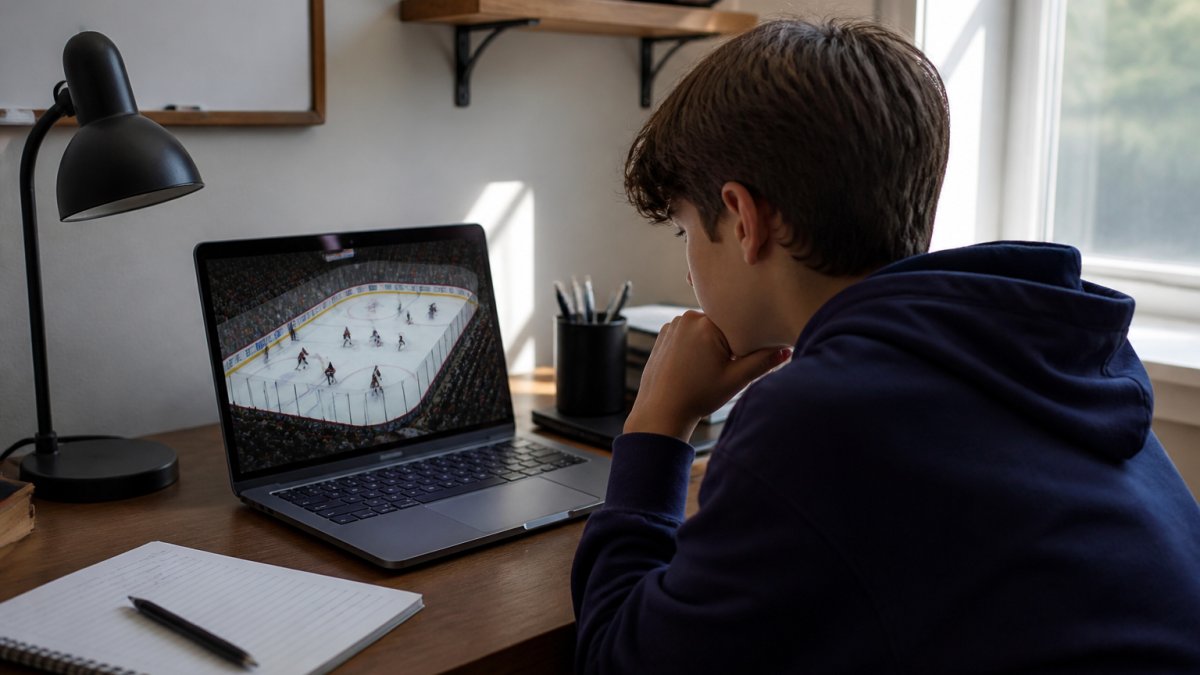
Monday and Wednesday: Film Study Sessions
These days focus on watching and learning.
- Time: 20-30 minutes
- What to do: Pick one game. Watch a full period without pausing. Then go back. Pause at three key moments. Study why each play happened. Write down one thing you learned from each moment.
- Focus: One zone per session (defensive zone Monday, offensive zone Wednesday). This keeps your brain focused.
By the end of four weeks, you'll have watched 12 key moments. Your pattern recognition will improve dramatically.
Tuesday and Thursday: Cognitive Drills
These days build decision speed.
- Time: 15 minutes
- What to do: Do five freeze-frame analysis exercises. Pause game film randomly. You have five seconds to predict the next play. Write your prediction. Then let the play continue. Did you get it right?
- Focus: Build speed. Don't overthink. Your first instinct is usually right.
This trains your brain to recognize patterns and react instantly.
Saturday: Game-Film Breakdown
This is your deep-dive session.
- Time: 30-45 minutes
- What to do: Watch a full game (or a full period). This time, focus on one player. Follow that player for the entire period. Where do they move? What decisions do they make? How do they support teammates? What mistakes do they make?
- Focus: Pick a player in your position. Study how elite players think the game.
By the end of four weeks, you'll understand how skilled players see the ice.
Measuring Your Hockey IQ Improvement
You can't improve what you don't measure. Track these metrics:
In-game observation: During your next game, count how many times you predict the next play correctly. Aim to predict at least one play per period. After four weeks, you should predict two or three.
Positioning accuracy: Ask your coach to watch for this: How often are you in the right position? How often do you need to chase the puck? Fewer chase moments mean better hockey IQ.
Decision speed: During practice, notice how quickly you make passes. Do you hesitate? Or do you pass immediately? Fast decisions usually mean you read the play correctly.
Turnover reduction: Keep track of turnovers you cause through bad positioning or poor decisions. After four weeks of home study, this number should drop.
These aren't perfect metrics, but they show progress. Track one or two of them. You'll see improvement in three to four weeks.
Adapting These Methods for Your Age and Skill Level
Hockey IQ training looks different depending on where you are.
Ages 5-8: Keep it simple. Watch short clips (5-10 minutes max). Focus on one concept at a time.
Ages 9-12: Increase film study to 15-20 minutes. Add freeze-frame analysis. Do five decision-speed exercises.
Ages 13+: Full 30-minute film sessions work. Add detailed note-taking. Do the complete weekly plan above.
Adult beginners: Start with the full plan. You have the focus and patience for deep study.
Competitive players: You already have solid hockey IQ. Use film study to study specific opponents. Watch their patterns.
The core principle stays the same: watch, learn, practice, measure.
Conclusion: From Home Study to Game Performance
Building hockey IQ at home works. Film study, visualization, and decision-speed drills train your brain to read plays faster and position better. You don't need ice time or expensive equipment. You just need consistency.
Start with one drill this week. Do film study on Monday. Add a decision-speed exercise on Tuesday. Build from there. In four weeks, you'll notice the difference. Your positioning improves. Your decisions speed up.
The challenge most young players face isn't lack of skill, it's lack of game awareness. They know how to skate and shoot. They don't know where to be or when to move. That's where Hockey Positioning™ comes in.
Frequently Asked Questions
Can you really improve hockey IQ at home without skating?
Yes. Hockey IQ depends on reading plays, recognizing patterns, and making faster decisions, skills you build through film study, visualization, and cognitive drills. These don't require ice time. When you return to the rink, your brain will process game situations faster because you've already studied them. Many players combine home study with on-ice practice for the fastest improvement.
How often should you work on hockey IQ to see real results?
Consistency beats intensity. Aim for 3-4 focused sessions per week, 20-30 minutes each. Film study on two days, cognitive drills on two others, and a longer breakdown session once weekly works well. Most players notice sharper decision-making and better positioning within 4-6 weeks of regular practice. Skipping weeks slows progress, so build it into your routine like you would ice time.
What should a hockey player watch for when reading a play?
Focus on three things: where the puck is going next, where defenders are positioned, and where open ice exists. Watch for passing lanes, stick positioning, and how players support each other off the puck. Notice how skilled players scan the ice before receiving it, they already know their options. Study breakouts, transitions, and how teams create space. Freeze frames help you pause and analyze these decisions without the speed overwhelming you.
Is an interactive app like Hockey Positioning™ better than just watching YouTube for learning positioning?
Interactive learning sticks better than passive watching. With Hockey Positioning™, you drag the puck and see players move to correct positions in real time, plus you get pro coaching tips at every location. This active participation forces your brain to think about why players move where they do. YouTube shows you what happens; interactive tools teach you why it happens and let you experiment with different scenarios instantly.