 how-to
Why Positional Awareness Matters for Youth Hockey
Table of Contents
- What Positional Awareness Actually Does for Young Players
- How Positional Awareness Stops Puck Chasing and Builds Game IQ
- Youth Hockey Offensive Positioning: Where Players Need to Be
- Youth Hockey Defensive Positioning: Responsibility and Transition
- Hockey Positional Awareness Drills: Teaching Movement Patterns
- How to Improve Hockey IQ at Home: Reinforcing Positioning Off the Ice
- Age and Skill-Specific Positioning: What to Expect at Different Levels
- Conclusion: Building Confident, Positionally Aware Players
- Frequently Asked Questions
Last Updated: October 19, 2026
What Positional Awareness Actually Does for Young Players
Understanding why positional awareness matters for youth hockey starts with recognizing that it's a player's ability to know where to be on the ice at the right time and understand what teammates are doing around them.
Most youth coaches see the same problem: kids follow the puck like a magnet, cluster around it, leave gaps, and miss chances because nobody is in the right spot.
Positional awareness changes everything. When players understand their role and positioning:
- They make smarter decisions faster
- They support teammates with better passing options
- They reduce turnovers by being in passing lanes
This is where the real edge comes from on the ice.
How Positional Awareness Stops Puck Chasing and Builds Game IQ
Puck chasing is the enemy of youth hockey development. When five players chase the puck, four are in the wrong place, the opponent gets space, and your team loses control of the game.
Game IQ, the ability to read the ice and make smart decisions, builds directly from positional awareness.
Here's what happens when positional awareness improves:
- Players stop bunching up around the puck
- They spread out and create space for teammates
- They recognize defensive gaps and attack them
According to research from USA Hockey's coaching development resources, youth players who receive structured positional training show measurable improvement in decision-making and game awareness within 4-6 weeks of focused practice.
The key is teaching players to think two steps ahead: instead of "where is the puck now," they ask "where should I be to help my team." Interactive tools like Hockey Positioning™ make this visual, players drag the puck across the ice and instantly see where everyone should move, building that mental map through repetition and visual feedback.
Youth Hockey Offensive Positioning: Where Players Need to Be
Offensive positioning isn't random. Every player has a job. Understanding those jobs is what separates coordinated teams from chaotic ones.
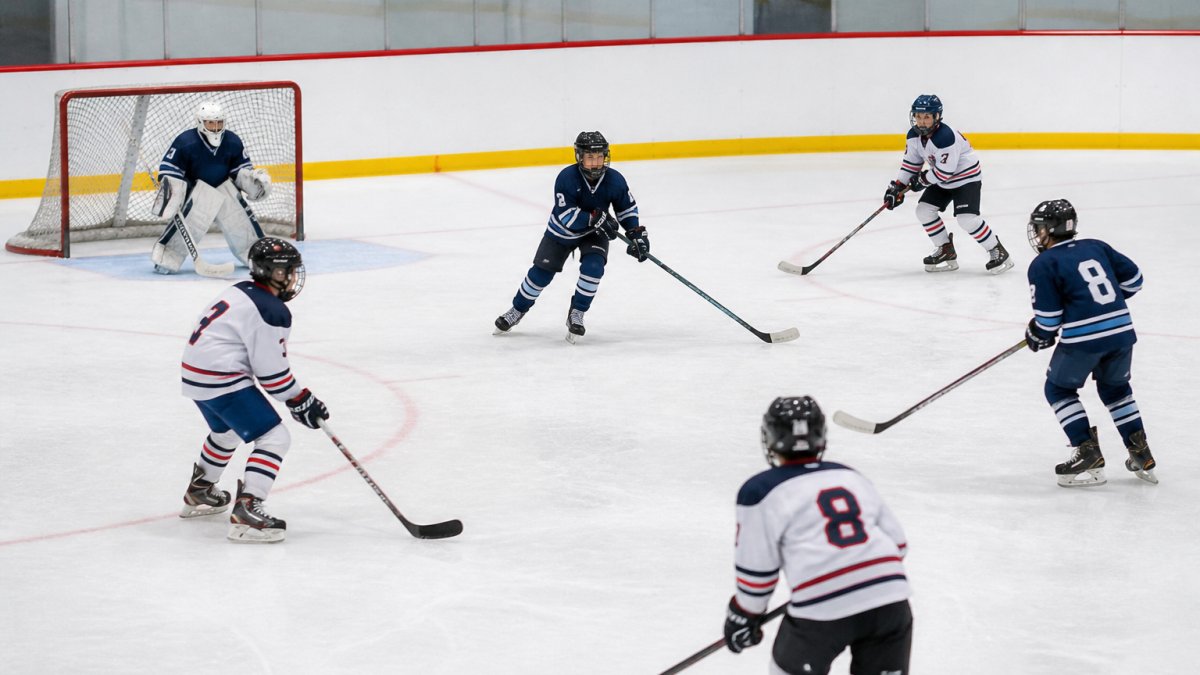
Forward positioning and support options
Forwards need to understand spacing and support. A forward without support is a turnover waiting to happen.
In the offensive zone, forwards should position themselves so that:
- The puck carrier always has at least two passing options
- Players create a triangle or diamond shape with spacing between them
- Each forward knows if they're the "high" forward, "middle" forward, or "low" forward
Young players bunch together because they watch the puck. Instead, they should watch teammates and find open ice; when one forward moves, the others adjust to maintain spacing and support.
Position-specific responsibilities matter:
- Center: Typically the playmaker. Position in the middle of the ice to receive passes and distribute. Move to open ice when wingers have the puck.
- Wingers: Stay wide to create space. Move into the middle when the center has the puck. Use the boards as a wall to keep the puck in play.
- Support forward: The player without the puck who is closest to the puck carrier. This player should be ready to receive a pass or take a rebound.
Creating passing lanes and spacing
Passing lanes are created by positioning. Three forwards in a line leave nowhere for the puck to go; spread out with space between them, the puck carrier has options.
Good spacing means:
- Players are 8-12 feet apart (roughly a stick length)
- No two players are directly in line with each other
- Each player can see the puck carrier and move toward them quickly
When young players learn to create space intentionally, they stop forcing bad passes and make better decisions because they have real options. Teams that understand spacing control the puck and create scoring chances.
Youth Hockey Defensive Positioning: Responsibility and Transition
Defense wins games at every level, but it only works when players know their positioning and responsibilities.
Defensive positioning is about coverage, support, and preventing scoring chances. Each player has a zone or player to watch; when everyone understands their job, the unit stays tight and organized.
Defensive-zone coverage and player roles
In the defensive zone, players typically use one of two systems: zone defense or man-to-man defense.
Zone defense means each player is responsible for a specific area of the ice.
Man-to-man defense means each player watches a specific opponent.
Defensive responsibilities by position:
- Defensemen: Protect the blue line. Stay between the puck and the goal. Clear the crease and prevent scoring chances.
- Forwards: Pressure the puck carrier in the defensive zone. Support defensemen. Prevent passes to the slot area.
- Center: Often the first forward back. Responsible for helping the defensemen and breaking up plays in front of the net.
When young players understand these roles, they stop wandering, stay focused, and make defensive plays instead of chasing the puck into bad positions.
Transition play and moving from defense to offense
Transitions are where games are won and lost. The team that moves from defense to offense faster creates scoring chances.
Good transition positioning means:
- Defensemen move the puck quickly to forwards
- Forwards position themselves to receive outlet passes
- Players spread out immediately after gaining possession
Young players often err in transition because they don't know where to go, boards, middle, or waiting for a pass.
According to American Development Model guidelines for youth hockey, teaching transition positioning at younger ages builds habits that players carry into competitive hockey.
Hockey Positional Awareness Drills: Teaching Movement Patterns
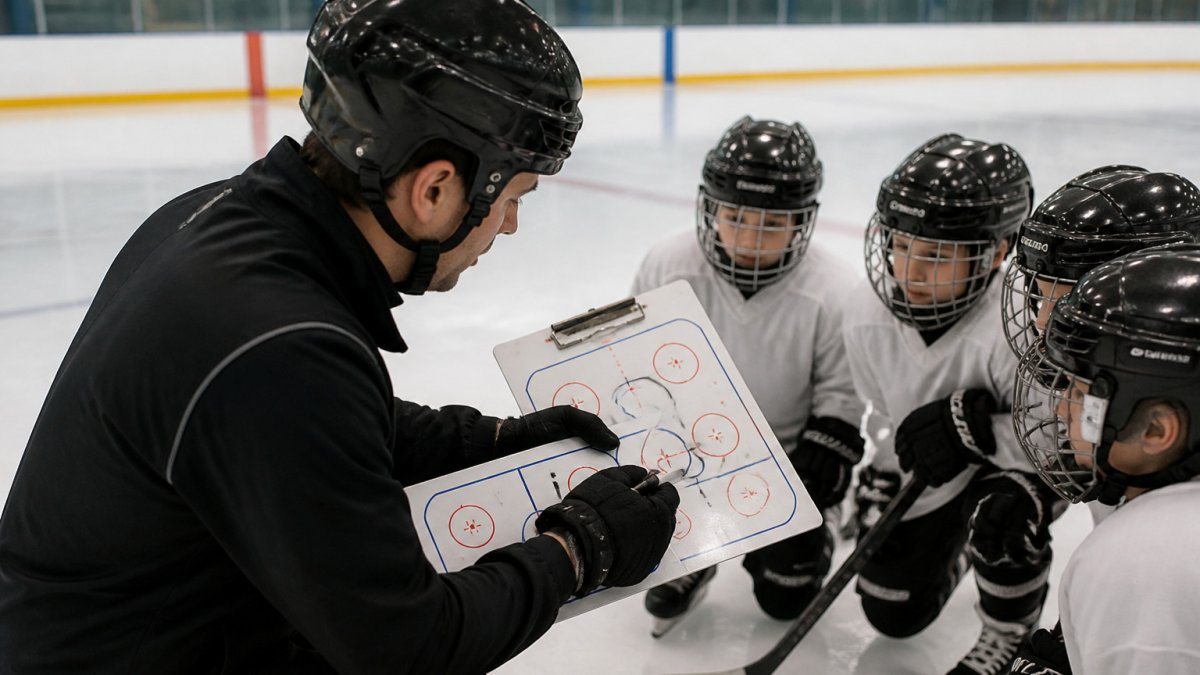
Drills teach patterns, which is exactly why positional awareness matters for youth hockey. The more a player repeats the correct pattern, the faster it becomes automatic.
Effective drills for positional awareness share common features:
- They focus on ONE concept at a time
- Players repeat the same movement 8-12 times per drill
- Feedback is immediate (coach correction or visual tool)
Small-area games and constrained practice spaces
Small-area games force better positional play: with less ice, spacing matters more, players can't hide, and they have to make good decisions.
Small-area games work because:
- Players touch the puck more frequently
- Decision-making happens faster
- Spacing mistakes are immediately obvious
A 3-on-3 game in the offensive zone teaches offensive positioning. Players learn where to be to create space and support.
These games build skill transfer because they're competitive and game-like, players are motivated to position correctly because it directly impacts scoring and preventing goals.
Game-situation training and decision-making under pressure
Game situations teach players to decide when it matters; drills simulating real game pressure build confidence and game IQ.
Effective game-situation drills include:
- 3-on-2 breakouts (practice transition positioning)
- 2-on-1 scenarios (teach support and spacing)
- Power play and penalty kill situations (teach special teams positioning)
With repeated practice, players stop thinking and start reacting, their positioning becomes automatic, and that's when real improvement happens.
Tools like Hockey Positioning™ accelerate this learning by showing players exactly where to move in every situation. Instead of waiting for a coach to explain, players see the correct positioning instantly after each puck movement.
How to Improve Hockey IQ at Home: Reinforcing Positioning Off the Ice
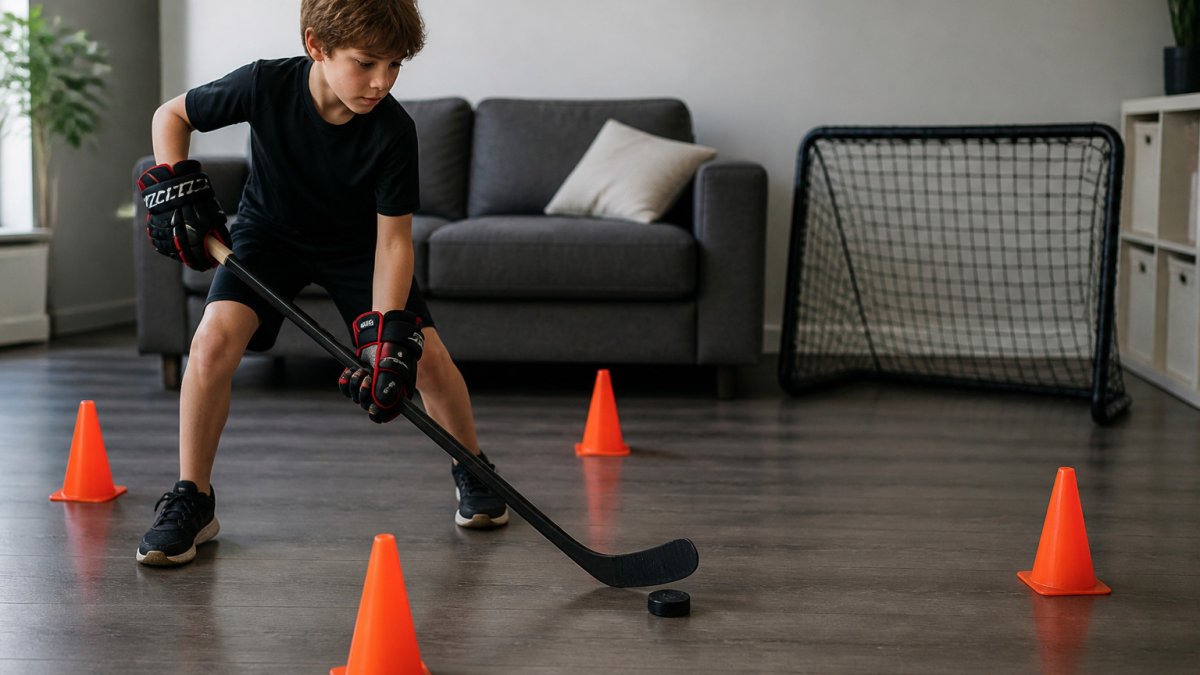
Parents can reinforce positional awareness at home. You don't need ice or a rink.
Visual learning and interactive tools for skill transfer
Visual learning is powerful: seeing correct positioning repeatedly builds mental patterns that transfer to the ice.
Interactive tools let players practice positioning anytime, anywhere, working through scenarios, seeing how positioning changes with puck movement, and learning the "why" behind each position.
This type of learning works because:
- It's visual, not just verbal
- Players can pause and study each position
- They can repeat scenarios as many times as they want
Hockey Positioning™ uses this exact approach. Players drag the puck across an interactive ice surface and see all five players move to their correct positions.
Measuring whether players truly understand positioning
How do you know if a player actually understands positioning? They can explain it and show it.
Test understanding by asking:
- "Why is that player in that spot?"
- "Where should you be if your teammate has the puck here?"
- "What would happen if everyone moved one step closer to the puck?"
Players who understand positioning can answer these questions, explain the reasoning, and adapt to different situations; players just following instructions can't.
Watch for these signs that positioning is becoming automatic:
- Players move to open ice without waiting for instructions
- They anticipate where play is going
- They support teammates naturally
When you see these signs, the learning is sticking. The positioning is becoming part of their game.
Age and Skill-Specific Positioning: What to Expect at Different Levels
Positional awareness develops over time. Expectations should match age and experience.
Ages 5-7 (Beginner): Focus on basic spacing and staying out of the way.
Ages 8-10 (Intermediate): Introduce position-specific roles. Teach forwards and defensemen different responsibilities.
Ages 11-13 (Advanced): Build complex positioning concepts.
The research from Hockey Canada's development model shows that age-appropriate progression is critical.
Competitive level also matters. Recreational players need different positioning focus than competitive players.
Conclusion: Building Confident, Positionally Aware Players
Positional awareness is the foundation of good hockey. Players who understand where to be and why make better decisions, create more scoring chances, and play with confidence.
Building this awareness takes time and repetition. It requires teaching the "why" behind positioning, not just the "where." It requires practice that builds understanding, not just drill repetition.
Hockey Positioning™ makes this process faster and more visual. Players see correct positioning instantly for every game scenario, from power plays to penalty kills.
Frequently Asked Questions
What does positional awareness mean in hockey?
Positional awareness is understanding where you should be on the ice at any moment based on where the puck is, where your teammates are, and what play is happening. It means knowing your role, whether you're supporting the puck carrier, covering an opponent, or moving into a passing lane, without having to be told. Young players with strong positional awareness stop chasing the puck and instead anticipate where play will develop, making smarter decisions and supporting their team's movement patterns.
How can parents help a child improve hockey IQ at home?
Parents can reinforce positional awareness at home using interactive visual tools that show game scenarios from different angles. Rather than complicated diagrams, interactive applications let young players drag the puck across a full ice surface and see where every player should move in response. Watching game film together and asking questions like 'Why did that forward move there?' also builds tactical awareness. Consistent, game-like practice reinforces skill transfer so players recognize positions during real matches.
Why do young hockey players struggle with positioning if their coach teaches it at practice?
Coaching at practice teaches positioning, but one or two sessions per week isn't enough repetition for young players to internalize it. Many struggle to transfer what they learn in drills to actual game situations because the pressure, speed, and complexity feel different. Additionally, traditional coaching methods like whiteboard diagrams or verbal instruction may not always stick as well as visual, interactive learning. Focused, intentional practice outside of team sessions, using tools that show real-time positioning feedback, helps players develop the tactical awareness needed to recognize positions instinctively.
At what age should young players start learning positional awareness?
Positional awareness can begin as early as age 5-6 with simple concepts like 'stay with your player' or 'support the puck carrier.' As players progress through competitive levels, positioning becomes more sophisticated: forwards learn spacing and passing lanes, defensemen learn zone coverage, and all players learn transition positioning. Age-specific adaptations matter, younger players benefit from visual, game-like practice with fewer variables, while older or more advanced players can handle complex systems like power plays and penalty kills. Interactive learning tools designed for different age groups make this progression accessible and engaging.