 how-to
Why Your Child Keeps Skating to the Puck
Table of Contents
- Understanding Why Children Skate to the Puck
- How to Teach Hockey Positioning to Kids
- Skating Through the Puck: Step-by-Step Coaching Cues
- Hockey Awareness Drills for Kids
- What to Do Without the Puck in Hockey
- How to Teach Passing in Youth Hockey
- Common Mistakes Parents and Coaches Should Address
- Tracking Progress and Troubleshooting
- Frequently Asked Questions
Last Updated: October 14, 2026
Understanding Why Children Skate to the Puck
Your child chases the puck, skating to the puck directly, stops, and waits. It's one of the most common behaviors in youth hockey.
The question isn't whether your child does this. It's why. Understanding the root cause changes how you coach the problem.
The developmental stage and instinct
Children skate to the puck because instinct tells them to. In their mind, the puck is the goal, and getting to it means good things happen. This peaks around ages 5-8, when kids lack the spatial awareness to anticipate where the puck will be, so they can only react to where it is now.
Technique issues versus natural behavior
Not every child who engages in skating to the puck has a technique problem. Some are simply playing the game the way their brain naturally understands it.
Here's how to tell the difference:
Natural behavior (developmental):
- Child accelerates toward the puck but loses momentum as they arrive
- They stop or glide right at the puck
- They look down at the puck instead of ahead
Technique issue (fixable):
- Child's stride breaks down before reaching the puck
- Their upper body leans too far forward or back
- They're not pushing hard enough to maintain speed
The developmental stage usually resolves with time and exposure; technique issues need direct coaching. Most kids this age have both happening at once, which is why patience matters.
How to Teach Hockey Positioning to Kids
Teaching positioning to kids under 10 is different from teaching teenagers. They think in concrete terms, "Go here. Do this." Abstract concepts like "support the play" don't land yet.
The solution: break positioning into simple, visible rules they can follow.
Building body position awareness
Before a child can position correctly, they need to feel what it looks like in their body.
Start with this drill on the ice:
- Have your child stand still with the puck at their feet
- Ask them to look straight ahead, not down
- Have them feel where their stick is (it should be in front of them, not dragging behind)
- Have them bend their knees slightly (this is the "ready position")
This takes two minutes before every practice and builds muscle memory.
Next, add movement:
- Roll the puck slowly across the ice in front of them
- Have them skate alongside it (not directly at it)
- Tell them to keep their head up and eyes on the puck, but not looking down at it
- Have them practice stopping beside the puck, not on top of it
This teaches the difference between chasing and positioning. When a child stops beside the puck instead of on it, they've made real progress.
Introducing spacing and anticipation
Spacing is the distance between your child and the puck; anticipation is predicting where it will go.
The two work together, kids who understand spacing naturally anticipate better.
Use this progression:
Week 1-2: Spacing awareness
- Place cones on the ice in a small square
- Have your child skate around the square while you roll the puck inside it
- Their job: stay on the edge of the square, not in the middle
Week 3-4: Simple anticipation
- Roll the puck toward a wall or board
- Have your child skate to where they think the puck will go, not where it is
- Start with slow rolls so they can be successful
Week 5+: Game-like situations
- Use a coach or another player to pass the puck
- Have your child position themselves to receive it
- This is where anticipation becomes real, they're reading another player's movements
The timeline matters less than the progression. Some kids move through these stages in weeks. Others need months. Both are normal.
Skating Through the Puck: Step-by-Step Coaching Cues
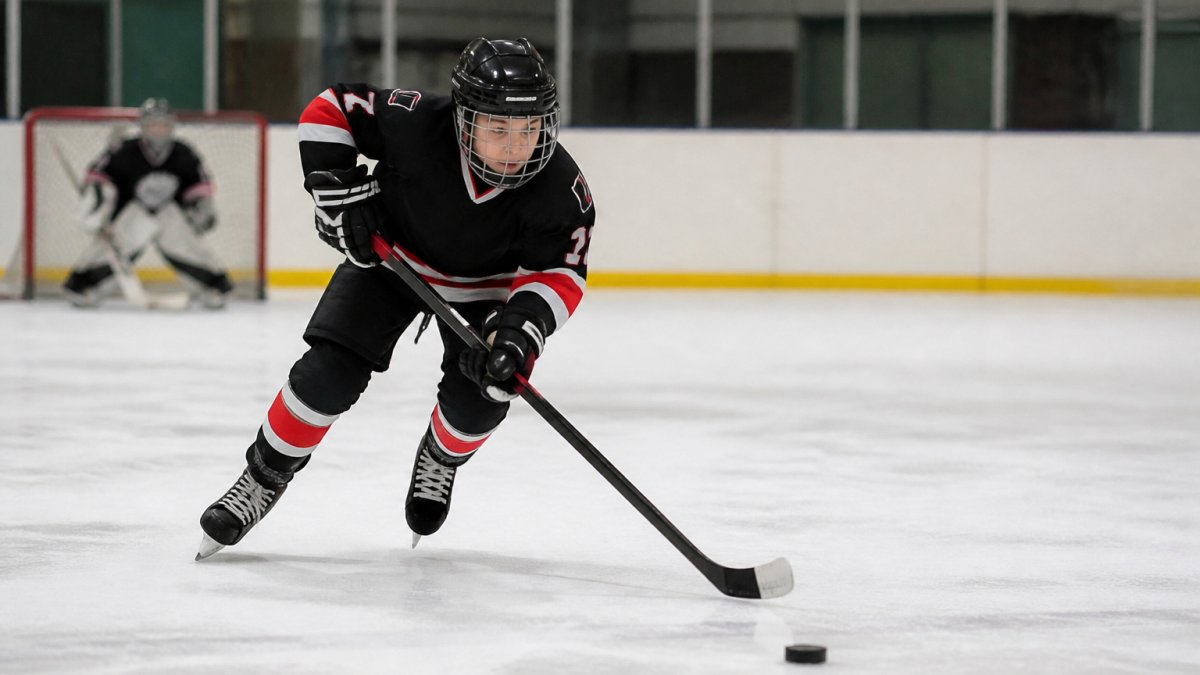
"Skate through the puck" confuses many parents and young coaches. It doesn't mean ignore the puck, it means maintain your speed and direction while getting it.
Stopping at the puck loses momentum; skating through it keeps the momentum that lets them make the next play.
Cue 1: Accelerate before you arrive
This is the most important cue: your child must speed up approaching the puck, not slow down.
Here's what that looks like:
- Three strides away from the puck: normal speed
- Two strides away: push harder
- One stride away: push hardest
Most kids do the opposite. They skate hard, then ease up as they get close. That's when they stop or glide.
Teach this with a simple drill:
- Place the puck on the ice
- Have your child start 20 feet away
- Tell them: "Skate faster as you get closer"
- Have them skate past the puck (not to it, past it)
- Repeat five times
This breaks the habit of slowing down. It teaches the body what acceleration feels like.
Cue 2: Keep your head up and eyes forward
When kids look down at the puck, their body follows their eyes: shoulders drop, stride shortens, speed drops.
Keep their head up. Eyes forward. Puck in their peripheral vision.
This is hard to teach because it feels unnatural, kids instinctively want to watch what they're trying to control.
Use this cue during every drill:
"Eyes up. Chin up. Skate like you're looking at the scoreboard, not the ice."
Repeat it until it becomes automatic.
Cue 3: Move your feet through the puck
This is the actual "skating through" part: your child's feet keep moving after they touch the puck.
It's the opposite of stopping. When they reach the puck, their feet don't freeze. They keep pushing.
Teach it like this:
- Have your child skate toward a stationary puck
- As they reach it, say: "Keep your feet moving"
- Have them take one more stride after they touch it
- Then stop
This teaches the feeling of momentum. After a few reps, it becomes the default instead of stopping.
Hockey Awareness Drills for Kids
Hockey awareness is knowing where the puck, your teammates, and the opposing team are all at once. Kids who skate to the puck usually have low awareness, they're focused on one thing: the puck.
Building awareness takes repetition. These drills work.
Drill 1: Loose puck races with movement focus
This drill teaches kids to skate hard toward a loose puck with their head up.
Setup:
- Two players start at center ice, 10 feet apart
- Coach rolls the puck between them
- Both skate toward it
Rule: The first player to reach the puck doesn't win.
This forces kids to skate through the puck, not to it. It makes the behavior competitive and fun.
Run it 2-3 minutes at the start of every practice.
Drill 2: Puck retrieval with continuous skating
This drill teaches kids that the play doesn't end when they get the puck.
Setup:
- Place three pucks in different areas of the ice
- One player skates to puck 1, gets it, and immediately skates to puck 2
- Then to puck 3
The goal: never stop moving. Never glide. Skate the whole time.
This builds the habit of continuous movement: getting the puck is just the start, and keeping your feet moving is what matters next.
Drill 3: Head-up skating and decision-making
This drill teaches awareness and decision-making together.
Setup:
- Place cones in a small area (about 20 feet x 20 feet)
- Inside the cones, place three pucks
- One player skates through the area with their eyes closed
This forces kids to rely on hearing and spatial memory rather than chasing what they see, building awareness because they must think about where things are instead of just reacting.
Run it 1-2 minutes. Kids find it challenging and fun.
What to Do Without the Puck in Hockey
Here's what most young players don't understand: the game happens when you don't have the puck.
When your child chases the puck, they're not thinking about where to be without it, they're just reacting. That's why positioning matters.
Positioning for support and passing lanes
Supporting a teammate means being in a spot where they can pass to you.
Teach it like this:
The triangle rule:
- Your child has the puck
- One teammate is ahead (forward)
- One teammate is behind (back)
Your child should always be in one of those spots, supporting the puck carrier (behind) or ready to receive (ahead).
This is concrete. Kids understand triangles. They can visualize it.
Practice it with a simple passing drill:
- Three players form a triangle
- One has the puck
- They pass to one of the other two
- That player immediately looks to form a new triangle
- Repeat for 2-3 minutes
Kids start positioning themselves naturally because they know they must be in the triangle to get the puck.
Reading the play and anticipating movement
Reading the play means understanding what's about to happen before it happens.
This is advanced. Kids under 8 usually can't do it. Kids 8-10 can start learning.
Teach it with game-like situations:
- Set up a simple 2v1 (two attackers, one defender)
- Have your child play defense
- Their job: predict which way the attacker will move
- Position themselves to take away that space
This teaches anticipation because they must think one step ahead, predicting what will happen instead of just reacting.
Start slow, then speed it up. Kids gradually develop the ability to read the play.
How to Teach Passing in Youth Hockey
Passing is connected to positioning. When kids understand passing, they understand why positioning matters.
Many young players don't pass because they don't trust teammates and think it's safer to skate to the puck themselves. Teaching passing builds confidence in both passer and receiver.
Building confidence through repetition
Kids need to make lots of successful passes. That's how confidence builds. Start with these conditions:
- Short distances (10-15 feet)
- Stationary targets (kids standing still)
- No defenders
Have your child make 20 successful passes before you add any difficulty. Then add:
- Moving targets (kids moving slowly)
- Longer distances (20-30 feet)
- Slightly harder passes
After 20 more successful passes, add:
- Defenders
- Game-speed movement
- Harder passes
This progression usually takes a few weeks of practice, but kids who go through it develop real confidence and start passing in games because they know they can.
Game situations and timing
The hardest part of passing is timing, releasing the puck at exactly the right moment so a teammate can receive it without breaking stride.
This only comes from lots of practice.
Use this drill:
- Two players skate side by side
- One has the puck
- When the coach says "Now," the passer releases the puck
- The receiver tries to get it without stopping
- Repeat 10 times
Then switch roles. Then add a third player. Then add a defender.
Each variation teaches timing differently. After weeks, kids develop an instinct for when to pass, they just do it.
Common Mistakes Parents and Coaches Should Address
Parents and coaches often make the same mistakes teaching positioning.
Mistake 1: Telling them to "stop chasing the puck"
Instead, teach them where to be. Give them a specific spot.
Mistake 2: Using abstract concepts
Use concrete language.
Mistake 3: Practicing positioning without the puck
Kids learn by doing.
Always include the puck, movement, and game-like situations.
Mistake 4: Expecting too much too fast
Positioning is a multi-year skill.
Be patient. Celebrate small improvements.
Mistake 5: Not communicating with the coach
If you work on positioning at home, tell the coach.
Consistency matters.
Tracking Progress and Troubleshooting
How do you know if your child is improving? What should you look for?
Signs of progress:
- They skate harder as they approach the puck (instead of slowing down)
- They keep their head up more often
- They take at least one stride after touching the puck
These changes don't happen overnight. Look for them over weeks and months, not days.
If progress stalls:
Sometimes kids plateau. They improve for a few weeks, then stop. This is normal.
Try:
- Changing the drill (same skill, different format)
- Taking a break from that specific skill and coming back to it
- Asking the coach what they see in practice
When to be concerned:
Most of the time, patience and consistent practice solve the problem.
Teaching your child to skate through the puck instead of to it takes time, but it's one of the most important skills they'll learn in youth hockey.
Frequently Asked Questions
Why do young hockey players chase the puck instead of staying in position?
Youth hockey players chase the puck because it's their natural instinct at early developmental stages. Young children focus on the most visible object and want to be where the action is. This behavior is normal but limits their effectiveness. As they develop hockey IQ and awareness, they learn to anticipate where the puck will go and position themselves accordingly. Coaching and repetition help them overcome this tendency and understand that staying in position and reading the play creates better scoring opportunities and stronger team play.
How do I teach my child not to chase the puck in hockey?
Teach your child to skate through the puck with momentum rather than stopping at it. Use coaching cues like 'accelerate before you arrive,' 'keep your head up,' and 'move your feet through the puck.' Practice drills that reward continuous movement and decision-making over simply reaching the puck first. Emphasize positioning and awareness, explain that good players know where to be before the puck gets there. Reinforce this with age-appropriate game scenarios and praise effort when they demonstrate proper positioning and hockey IQ, not just puck touches.
What should a hockey player do when they don't have the puck?
When without the puck, a player should position themselves to support the teammate with the puck, create passing lanes, and anticipate where play will move next. This means maintaining proper spacing, keeping your head up to read the play, and staying ready to receive a pass or move to open ice. Players should also work on puck protection by being in position to help defend or transition quickly. Understanding these positioning principles builds hockey awareness and makes your child a more complete player, reducing the urge to simply chase the puck around the ice.
At what age can kids start learning proper hockey positioning and awareness?
Children as young as 5 or 6 can begin learning basic positioning concepts through age-appropriate drills and coaching. At 5-7 years old (8U), focus on simple concepts like staying with a partner and basic body position. By 8-10 years (10U), introduce spacing, passing lanes, and reading loose pucks. Older children (11-13 years) can handle more complex strategies like power plays and penalty kills. Development varies by child, so coaches should match instruction to individual skill level and maturity, not just age. Interactive tools and visual learning help younger players grasp positioning faster.