 blog
How to Learn Hockey Positioning as an Adult Beginner
Last Updated: October 25, 2026
Quick Summary
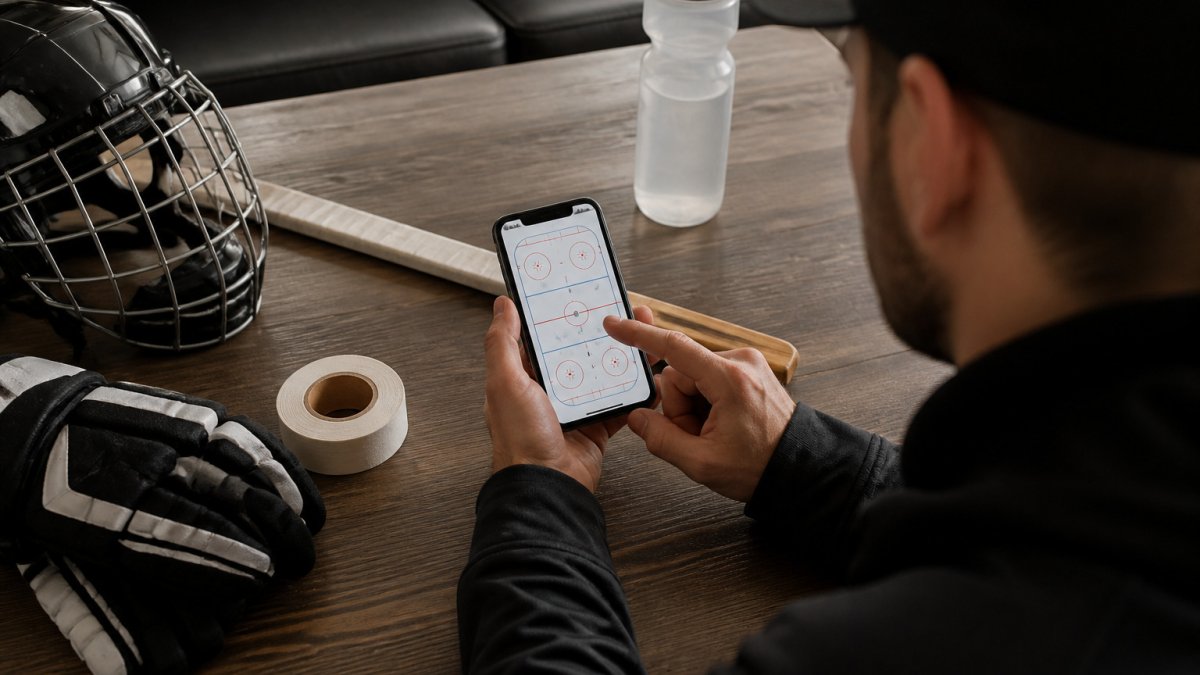
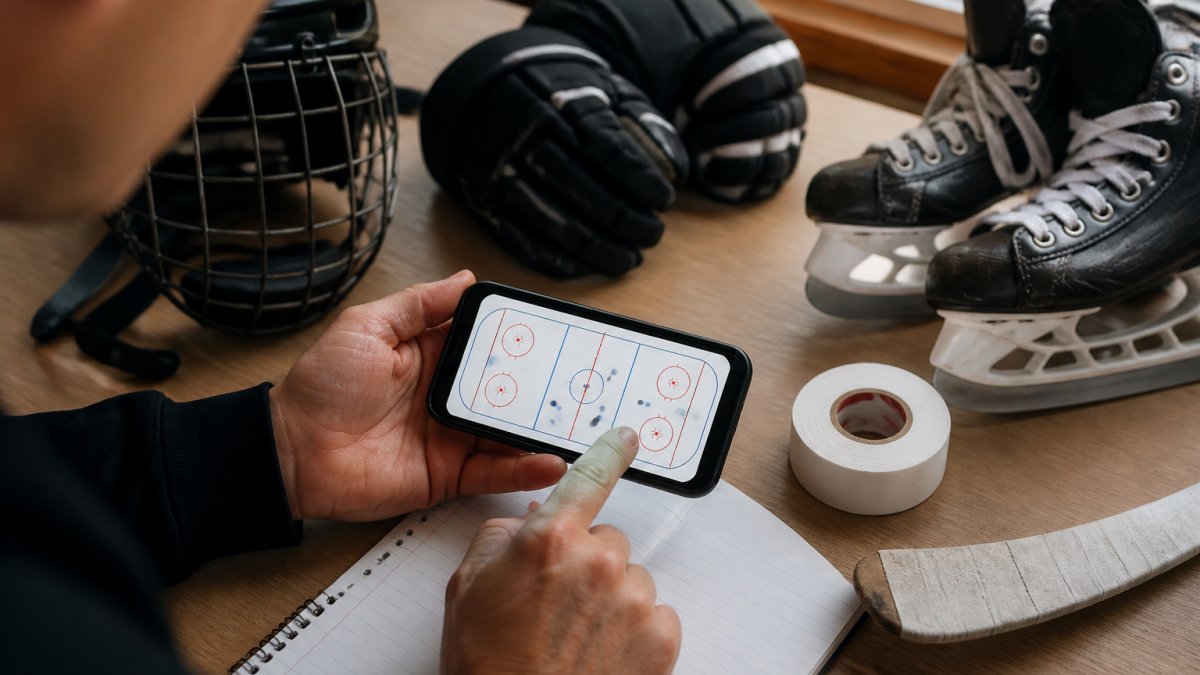
A hockey positioning app for adults turns abstract positioning into visual, hands-on learning by letting you drag the puck across an interactive ice surface and watch players move into their correct positions automatically. This combines visual, kinesthetic, and spatial learning modes, with pro coaching tips explaining the why behind each movement. Interactive, self-paced apps produce better retention for adult learners than traditional instruction.
- Adult beginners struggle with positioning because it requires seeing the entire ice and anticipating play, not just following the puck.
- The best hockey positioning app for adults teaches position-by-position responsibilities, not just team-level arrows or drill-building tools.
- Adults retain spatial information better through spaced 10-15 minute sessions three times weekly than through cramming or passive instruction.
- Transfer to on-ice play happens when you use the app to build awareness, then focus on those concepts deliberately during games and scrimmages.
- Effective apps include pre-built scenarios for 5-on-5, power plays, penalty kills, and transition play with plain-language onboarding for beginners.
Table of Contents
- Why Adult Beginners Struggle With Hockey Positioning
- How to Learn Hockey Positioning With Interactive Apps
- Hockey Training Apps for Adults: What Sets Them Apart
- Improving Your Hockey IQ App Skills Through Visual Practice
- Using a Hockey Tactics Board App to Master Game Scenarios
- From App Learning to On-Ice Performance
- Getting Started With Your Hockey Positioning App
- Frequently Asked Questions
Why Adult Beginners Struggle With Hockey Positioning
Adult recreational players learn the game's spatial logic as complete adults, often after years away from the ice.
Positional play isn't intuitive. Learn the specific challenges adult learners face with hockey positioning Unlike shooting or passing, it requires seeing the entire ice, reading teammates' movements, and anticipating play development.
Research from coaching effectiveness studies on adult learners shows adults retain information better through visual, interactive practice than passive instruction.
How to Learn Hockey Positioning With Interactive Apps
This combines three learning modes: visual (you see the positions), kinesthetic (you're dragging the puck), and spatial (you're grasping the whole-ice picture). Move the puck and the app shows exactly where each winger, defenseman, and center should be, you're experiencing the logic, not reading a diagram.
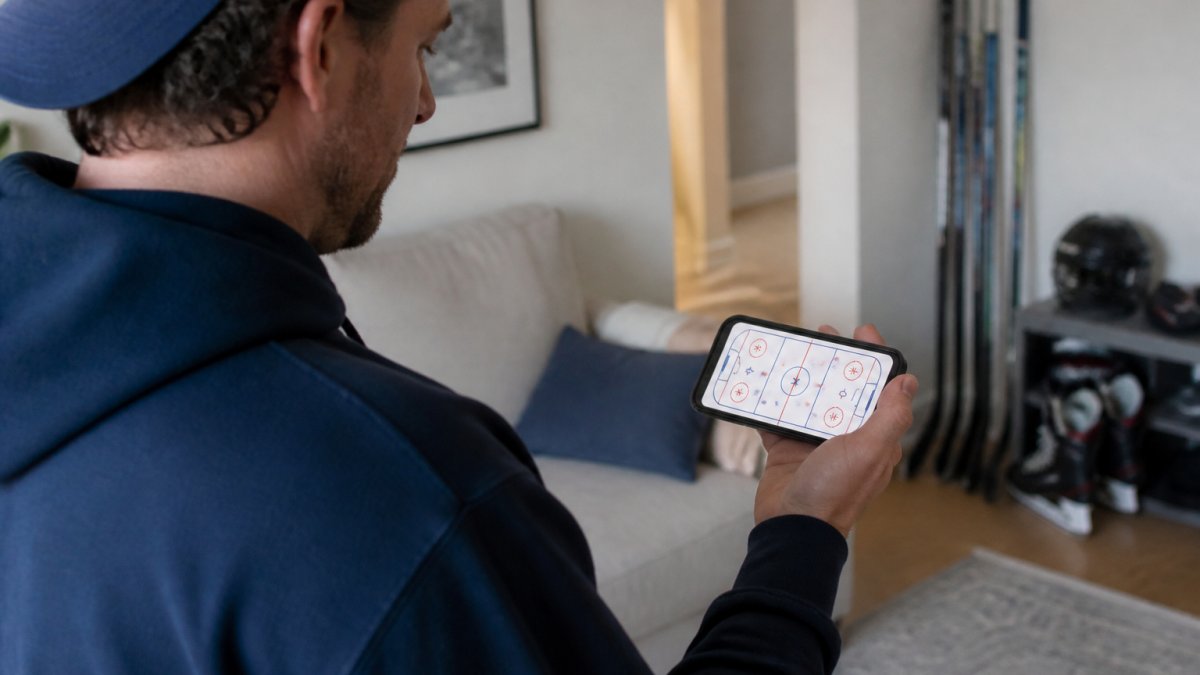
The best apps include pro coaching tips at every puck location.
Many adult apps also let you customize jersey colors, when the team feels like yours, you engage more deeply and learn how your team should move.
adult learning retention research from educational psychology confirms that interactive, self-paced learning with immediate visual feedback produces better retention than traditional instruction.
Hockey Training Apps for Adults: What Sets Them Apart
Most hockey apps serve coaches designing drills or youth programs. Adult recreational players sit in between, and the wrong app wastes your time. A hockey positioning app for adults should be judged on whether it teaches you where to be, not whether it builds a drill library.
Here's a practical evaluation framework based on what separates positioning tools from coach-first drill builders.
1. Adult-beginner onboarding and terminology
A positioning app for adults should explain roles, zones, and basic coverage before asking you to drag a puck. Look for plain-language labels ("strong-side winger," "high slot," "backdoor") with short definitions, not just arrows. If the first screen assumes you know what a 1-3-1 power play is, it was built for coaches. A useful test: can a complete beginner pick "5-on-5 defensive zone" and understand what to do without a glossary?
2. Position-by-position learning outcomes
The strongest adult positioning apps teach responsibilities by position, not just team shape. For each scenario, you should see what the center, wingers, and defensemen are each responsible for during offense, defense, and transition, adult players often rotate positions or fill in wherever needed.
Check whether the app answers:
- Center: Where should I support the puck carrier, and when do I become the low forward in the defensive zone?
- Wingers: When do I pressure the point, and when do I collapse to the slot?
- Defensemen: How do I gap up in transition, and when do I step up versus retreat?
If it only shows team-level arrows without position-specific responsibilities, it's a tactics board, not a positioning tutor.
3. Scenario depth versus drill-building depth
Coach-first apps excel at drill creation, drawing, animating, and sharing custom plays. Adult learners rarely need that. They need a pre-built library of realistic game states: even strength, power play, penalty kill, transition, and zone coverage.
- Coach-first tools: strong on custom drill creation, weak on beginner instruction.
- Positioning-first tools: strong on pre-built scenarios and explanations, weaker on custom play design.
- Hybrid tools: offer both, but often bury the beginner content under coach features.
For adults, prioritize the pre-built scenario library and explanation quality over drawing your own plays.
4. Visual clarity and adult learning needs
Adult learners benefit from readable visuals, consistent color coding, and the ability to pause and replay. Check whether player icons are distinguishable, the puck path is clear, and the app explains the why behind each movement.
Also assess accessibility: font size, contrast, and whether it works without sound. Adults often study in short bursts on a phone, so a clean mobile layout matters more than a desktop-grade tactics editor.
5. Platform, offline access, and sharing
Most adult players learn on a phone or tablet during a commute or before a game. Confirm iOS and Android availability and offline viewing. Sharing scenarios with teammates is secondary to scenario quality.
6. Free access and subscription transparency
Before committing, identify what's free, what requires a subscription, and how cancellation works. A common pattern is a limited free scenario set with full access behind a subscription, test the free content first to confirm the teaching style fits.
7. Independent testing signals
App-store descriptions rarely tell you whether onboarding works for a beginner. Look for independent reviews describing the first 10 minutes, the quality of explanations, and whether the learner improved. If none exist, treat "hockey IQ" marketing claims cautiously and rely on the free tier.
For a broader shortlist, see 7 Best Hockey Training Apps for Adults.
Adult positioning apps should be evaluated on these key criteria to ensure they teach positioning rather than just drill design.
| Evaluation Criterion | What to Look For | Why It Matters for Adults |
|---|---|---|
| Adult-beginner onboarding | Plain-language labels and definitions before complex scenarios | Prevents confusion if you don't know coaching terminology |
| Position-by-position learning | Separate responsibilities for center, wingers, defensemen | Adults rotate positions and need role-specific guidance |
| Pre-built scenario library | Realistic game states over custom drill creation | Adults need realistic practice, not drill-building tools |
| Visual clarity and explanations | Readable visuals, pro coaching tips, pause and replay | Adults learn better with clear visuals and the why behind movement |
| Platform and offline access | iOS and Android with offline viewing capability | Adults study on phones during commutes or before games |
| Free access and transparency | Clear pricing and subscription terms before commitment | Allows testing teaching style before financial commitment |
| Independent testing signals | Reviews describing first 10 minutes and actual improvement | App-store claims alone don't confirm beginner effectiveness |
Improving Your Hockey IQ App Skills Through Visual Practice
Hockey IQ is the ability to read the ice and decide before the play arrives. For adults, the fastest path isn't watching more games, it's repeated visual exposure to specific game states with immediate feedback. A hockey positioning app for adults works when it turns that exposure into a structured progression.
A position-by-position progression
Most adult beginners try to learn all five positions at once and end up with a blur of arrows. Learn one position at a time, then rotate, this mirrors how recreational players actually fill in for teammates.
Center progression:
- Even-strength support: where to be relative to the puck carrier in the offensive zone.
- Defensive zone low support: when to become the low forward and cover the slot.
- Transition: how to position as the first forward back versus the first forward up.
- Power play: operating from the slot or half-wall depending on the setup.
Winger progression:
- Strong-side versus weak-side responsibilities in the offensive zone.
- Point coverage and collapse decisions in the defensive zone.
- Breakout positioning on the wall.
- Penalty-kill lane coverage.
Defenseman progression:
- Gap control in transition.
- Net-front coverage and boxing out.
- Point play on the power play.
- Penalty-kill pressure versus collapse.
For each position, the app should show the movement, explain the why, and let you repeat until the pattern feels familiar.
Short, spaced sessions beat cramming
Adult learners juggle work and family, so consistency beats duration. A practical schedule is 10 to 15 minutes, three times a week, one concept per session. Spacing lets your brain consolidate spatial information, three short sessions beat a single hour on Sunday because positioning is pattern recognition, not a fact to memorize.
A useful weekly structure:
- Session 1: Watch and drag through a new scenario without pressure.
- Session 2: Repeat the same scenario and predict player movement before dragging.
- Session 3: Mix the scenario with one adjacent game state (for example, even strength plus transition) to test transfer.
Build a spatial map, not a checklist
The goal isn't memorizing "winger stands here." It's building a mental map of the ice so that when the puck moves, you already know the open lanes and coverage responsibilities. Apps with pro coaching tips accelerate this by connecting the where to the why. When you can explain why a defenseman steps up rather than retreats, you've moved from memorization to understanding.
Test transfer deliberately
After a week on a concept, test it in a game or scrimmage. Pick one focus, defensive-zone collapse or transition gap control, and review it after. If you can't recall a specific moment where the app's pattern appeared, the concept hasn't transferred. Repeat the scenario and test again. This deliberate loop separates adults who improve quickly from those who collect app sessions without changing their play.
For deeper independent strategies, see Improve Hockey IQ at Home: A 2026 Guide.
Using a Hockey Tactics Board App to Master Game Scenarios
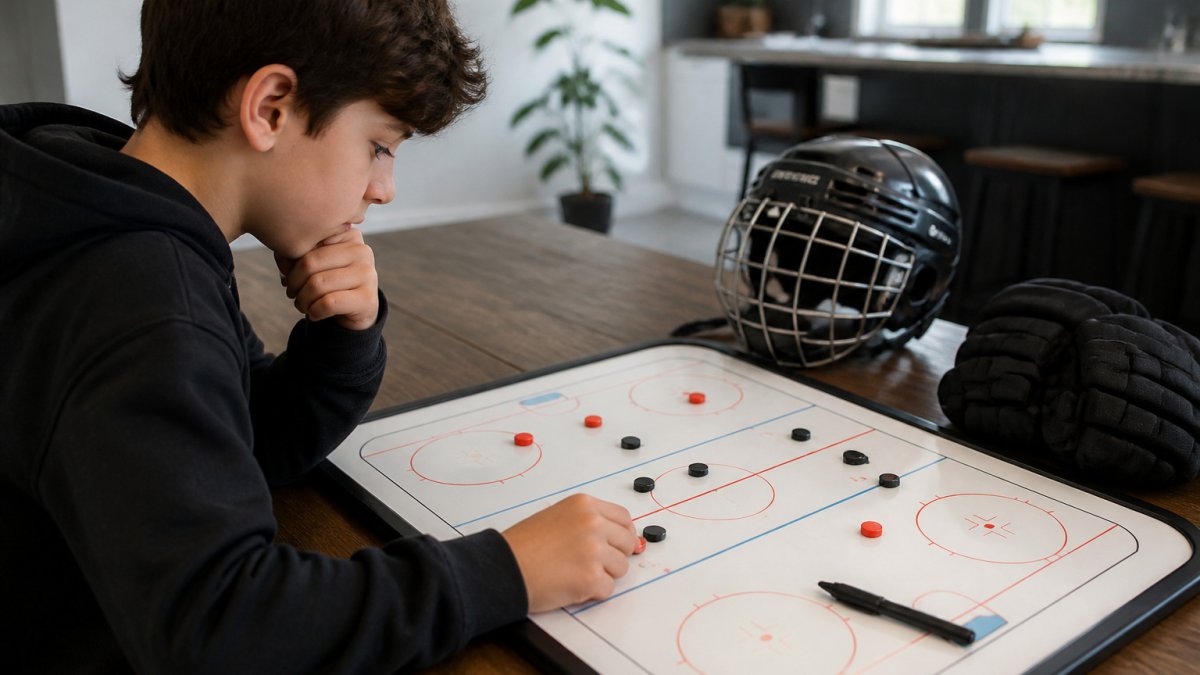
A hockey tactics board app differs from a positioning app, though the best platforms combine both. A tactics board lets you see and sometimes create custom plays, useful for understanding specific strategies your team uses. When your coach runs a specific offensive setup, pull up the tactic board, see the play drawn out, and understand the positioning and movement required.
Power Plays and Penalty Kills
Power plays and penalty kills are specialized situations where positioning matters even more. On a power play it's more aggressive; on a penalty kill, more defensive. A good app teaches both.
Adult beginners often feel lost on power plays: more players, tighter spacing, shifting roles. An app that walks you through power play positioning, where point players stand, where wings set up, how the center operates in the slot, gives you a framework to execute.
Transition Play and Defensive Positioning
Transition play is where the puck moves from defense to offense or vice versa, where adult beginners often panic because the ice is changing rapidly. A hockey positioning app for adults that isolates transition scenarios helps you position yourself during these chaotic moments.
You can explore more detailed defensive strategies through 5 Ways to Improve Defensive Zone Positioning, which covers specific drills and techniques that complement app-based learning.
From App Learning to On-Ice Performance
The biggest question adult beginners ask is whether app-based learning transfers to the ice. Yes, but only if you bridge the gap intentionally.
A practical approach: spend 10-15 minutes on the app learning a specific concept, then focus on it during your next practice or game. Studying transition positioning? Think about it consciously during transitions.
Many adult players notice a real shift after 4-6 weeks of consistent app practice combined with on-ice play: less puck-chasing, better anticipation, better position to receive passes and create scoring chances. The app doesn't replace on-ice practice, it accelerates learning so your ice time is more productive. Instead of spending a season figuring out where to be, you've internalized the patterns and can focus on execution.
Getting Started With Your Hockey Positioning App
Starting with a hockey positioning app for adults is straightforward, but a few approaches work better. First, choose an app for your experience level: complete beginners should start with basic 5-on-5 positioning before special teams; returning players can jump to more complex scenarios. Second, commit to a schedule, even 10 minutes three times a week makes a difference, because consistency beats duration. Third, focus on one concept at a time.
Hockey Positioning™ is built specifically for this journey. It features an interactive ice surface where you drag the puck and watch players move into position automatically, with pro coaching tips at every puck location so you understand not just where players go but why.
The app includes scenarios for all game states, 5-on-5, power plays, penalty kills, and transition play, giving you a complete education in positional hockey, not fragments. For adult beginners, that comprehensive approach is exactly what builds real hockey IQ.
Frequently Asked Questions
Can an app really help me learn hockey positioning if I'm just starting out?
Yes. Interactive apps designed for adult beginners translate complex positional concepts into visual, hands-on practice. By dragging a puck across a virtual ice surface and seeing players move into correct positions instantly, you build muscle memory and understanding without needing to be on the ice. This visual repetition helps you recognize positioning patterns faster than static diagrams or verbal coaching alone, and you can practice at your own pace.
How is learning hockey positioning on an app different from watching YouTube videos or having my coach draw plays?
Interactive apps let you control the scenario, you decide where the puck goes and see real-time position adjustments. Videos are passive; whiteboards show one moment at a time. Apps for hockey positioning let you explore multiple puck locations, test different plays, and understand cause-and-effect positioning instantly. This active engagement strengthens retention and helps you apply concepts during actual games.
Will practicing hockey positioning on my phone actually improve my game on the ice?
App practice builds positional awareness and decision-making speed, which transfers to the ice. You'll recognize where teammates should be, anticipate passing lanes, and reduce puck-chasing. However, app learning works best alongside on-ice practice. Use the app to understand tactics between practices, then apply what you've learned during games. Many adult players report faster positioning improvement when they combine visual app learning with regular ice time.
Is a hockey positioning app suitable for adults, or is it mainly for kids?
Quality hockey positioning apps are designed for both children and adults new to the sport. Adult-focused apps recognize that beginners of any age need clear visual instruction and self-paced learning. Look for apps that include adult-relevant scenarios like recreational league tactics, transition play, and defensive positioning, not just youth competitive strategies.
Learning hockey positioning as an adult is challenging, but it doesn't have to be slow. The right app compresses years of learning into weeks. Hockey Positioning™ transforms complex strategies into visual, interactive practice that actually sticks. With an intuitive interface, pro coaching tips, and scenarios for every game situation, you'll move from chasing the puck to playing with confidence and positioning. Download on the App Store and start building your hockey IQ today.