 blog
How to Tell If Visual Hockey Training Actually Works
Last Updated: October 30, 2026
Quick Summary
Visual hockey training can sharpen skills like tracking and reaction time, but the evidence that it improves real game performance is thin. Most studies test players in a lab, not on the ice, so treat it as a supplement to on-ice practice rather than a proven shortcut.
- Measured gains usually appear on the same drill that was trained, not in actual games.
- Most studies involve about 20 to 40 players and rarely track game statistics.
- Look for random assignment, a control group, and game-performance measures before trusting a claim.
- Try a free ten-minute drill twice a week for 12 weeks before paying for a program.
- Anyone with blurred vision, frequent headaches, or a concussion history should see an eye care professional first.
Table of Contents
- What Visual Hockey Training Claims to Do
- What the Research Shows and Where It Falls Short
- Visual Training Compared With On-Ice and Video-Game Practice
- Hockey Vision Drills That Target Tracking and Hand-Eye Coordination
- Hockey Reaction Time Training: What Can Realistically Change
- Sports Vision Training for Hockey Players: Protocol, Timeline and Cost
- Tracking Progress and Deciding Whether Your Child Should Keep Going
- Frequently Asked Questions
What Visual Hockey Training Claims to Do
Visual hockey training promises that better eyes make better players. This guide looks at what visual training actually claims, what the evidence supports, and how parents and players can judge results for themselves.
Sports vision training is a category of exercises meant to improve the visual skills an athlete uses during play. Those skills include tracking moving objects, judging distance, and noticing what is happening at the edges of the field of view. Providers typically say these skills transfer to faster decisions on the ice.
Visual tracking and following play
Tracking is the skill of keeping your eyes locked on a moving puck or player. Visual training programs claim that better tracking helps a player read the play before the puck arrives.
Watch out: a player who tracks the puck well can still chase it. Tracking tells you where the puck is, not where you should be.
Peripheral awareness and depth perception
Peripheral awareness means noticing teammates and opponents without turning your head. Depth perception helps a player judge how far away a defender or a pass target really is.
These two skills matter most in crowded areas near the boards and in front of the net. Claims about them are easy to make and harder to measure, which is why the next section matters.
What the Research Shows and Where It Falls Short
Most articles on visual hockey training either cite a single study or wave vaguely at "research." That does not help a parent or player decide whether to invest time and money.
Tier 1: Well-established findings. Visual skills can be measured reliably, and some can improve with repeated practice. Simple reaction-time tasks, for example, show consistent gains when people practice them.
Tier 2: Promising but unproven for game transfer. Several small studies in sports vision have found that athletes who complete training programs improve on laboratory tests of tracking, peripheral awareness, and hand-eye coordination. The problem is what happens next.
Tier 3: Claims that outrun the evidence. Some programs promise faster reaction time, better decision-making, and improved scoring within weeks. Those claims are rarely backed by peer-reviewed studies that measure game performance.
What would stronger evidence look like? A study that randomly assigns players to vision training or extra on-ice practice, follows them for a full season, and compares game statistics like turnovers, passes completed under pressure, and positioning errors. That kind of study is expensive and rare. Until it exists, the honest conclusion is that visual training is a reasonable supplement with plausible benefits, but it is not a proven shortcut to better hockey performance.
Visual Training Compared With On-Ice and Video-Game Practice
Visual training is one of several ways to build hockey IQ. The three main options are on-ice practice, video-game or app-based training, and dedicated visual exercises.
| Option | Strengths | Limitations | Best for |
|---|---|---|---|
| On-ice practice | Real speed, real contact, real teammates | Expensive, limited reps per session | Building game skill |
| Video-game training | Cheap, repeatable, easy to track | Does not match ice speed or contact | Repetition of game scenarios |
| Visual training | Targets specific visual skills | Transfer to games is unproven | Players who struggle with tracking |
Pros of visual training:
- Targets a specific skill
- Can be done at home
Cons of visual training:
- Transfer to the ice is not well shown
- Quality varies widely between programs
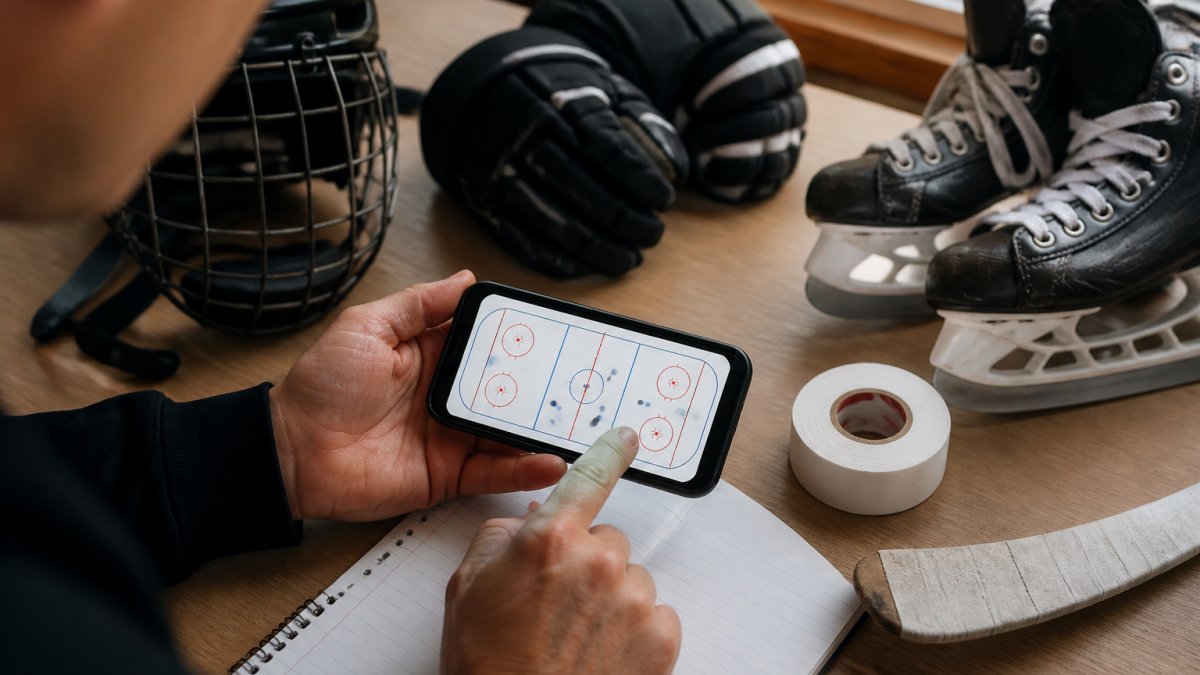
Hockey Positioning™ is an interactive mobile app that takes a visual-learning approach to positional play. See other hockey training apps for adults to compare what each one covers. Players can drag the puck across an interactive ice surface and see players move to their correct positions for game scenarios. For players who learn better by seeing scenarios, that kind of practice can complement on-ice time rather than replace it.
Visual learning tools are most useful when paired with coaching. Players learn the reasons behind a position, then apply them in practice. At-home ways to build hockey IQ compare visual training with other practical options.
Hockey Vision Drills That Target Tracking and Hand-Eye Coordination
Good drills are simple to set up and easy to repeat. Start with one drill for a few minutes at a time, then add a second once the first feels automatic.
Three drills worth trying:
- Ball tracking: Toss a ball between two hands while following a moving target with your eyes.
- Puck focus: Stand still and track a puck being passed back and forth by a partner.
- Eyes-up passing: Pass a ball while keeping your eyes on a point across the room.
Keep sessions short, about five to ten minutes. Focus on accuracy first, then speed.
If a player keeps chasing the puck, the issue is often positioning, not eyesight. Learn how to stop chasing the puck with positioning fixes that go beyond drills. Drills help, but coaching on where to stand matters just as much.
Hockey Reaction Time Training: What Can Realistically Change
Reaction time is how fast a player starts to move after seeing a signal. It is partly genetic and partly trained, so expect modest gains rather than dramatic ones.
A common mistake is to expect reaction drills to make a slow skater fast. They sharpen how quickly a player responds, not how fast the legs move.
Realistic goals include:
- Starting a movement a fraction of a second sooner
- Making quicker decisions when the play changes
- Keeping focus during long shifts
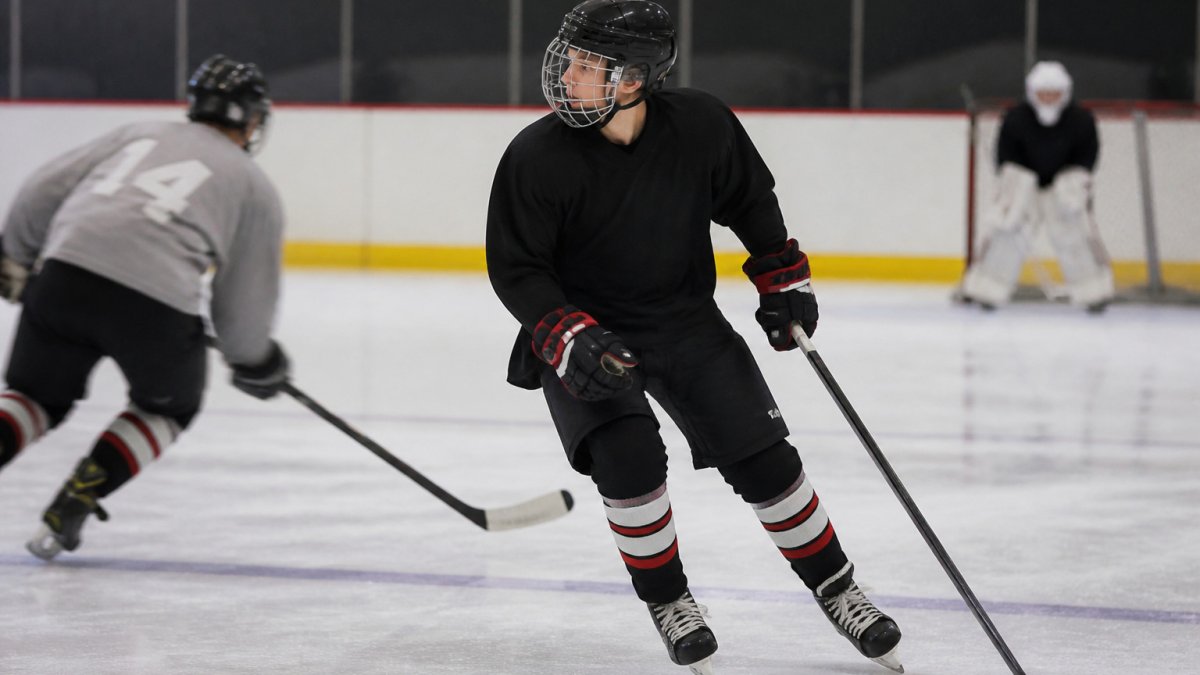
A young hockey player in full gear on an indoor rink, head up and scanning the ice while a teammate passes nearby, shows the kind of awareness reaction training aims to build.
Sports Vision Training for Hockey Players: Protocol, Timeline and Cost
A practical plan is more useful than a vague suggestion to "do some drills." Below is a realistic protocol that fits into a normal hockey week, along with honest expectations about timeline and a transparent look at cost and accessibility.
A realistic 12-week protocol
This assumes the player already has two or three on-ice sessions per week. Visual training is a supplement, not a replacement.
- Weeks 1-2 (foundation): One drill, five minutes per session, two sessions per week. Choose a simple tracking drill, for example, following a ball tossed between hands or tracking a puck passed by a partner. The goal is consistency, not intensity.
- Weeks 3-6 (build): Add a second drill, still five to ten minutes total per session, two or three sessions per week. Alternate tracking and hand-eye coordination. Keep a simple log: date, drill, and a one-word note on how focused the player felt.
- Weeks 7-12 (assess): Continue two sessions per week. Around week 8, ask the player's coach for one specific observation: does the player seem to scan the ice more or chase the puck less? At week 12, review the log and the coach's feedback. If there is no noticeable change in game behavior, consider stopping or trying a different approach.
Expected timeline
Most players notice small changes in how they feel on the ice within three to six weeks, for example, feeling more aware of nearby players. Measurable transfer to game statistics usually takes longer and is harder to confirm. A reasonable expectation is that any real change will show up over a full season, not a few weeks. Be skeptical of programs that promise dramatic results in 30 days.
Cost and accessibility: three tiers
Costs vary widely, and the most expensive option is not automatically the best. Here is a general comparison of the three main tiers.
| Tier | What it looks like | Typical cost range | Best for |
|---|---|---|---|
| Professional / clinical | One-on-one sessions with a sports vision specialist, often using specialized equipment | Highest; per-session fees plus assessment | Players with a specific diagnosed visual issue or elite players with budget |
| App-based / at-home programs | Guided drills via a phone or tablet, sometimes with a subscription | Low to moderate; often monthly subscription | Families who want structure and tracking at low cost |
| Free / low-cost DIY | Ball tracking, puck focus, eyes-up passing with a partner | Essentially free | Anyone starting out or testing whether they enjoy it |
A common mistake is to pay for a professional program before trying a free DIY routine for a month. If the player will not do ten minutes of ball tracking at home, a more expensive program is unlikely to fix that. Conversely, if the player is highly motivated and the free drills feel too easy, an app-based program can add structure and progression.
Who should see an eye care professional first
Visual training is not a substitute for an eye examination or corrective eyewear. Anyone with blurred vision, frequent headaches, double vision, or a history of concussion should see an eye care professional or doctor before starting any program. Children should have regular eye exams regardless of hockey participation. If a player struggles to track the puck, the first question is whether they can see it clearly, not whether they need more drills.
Tracking Progress and Deciding Whether Your Child Should Keep Going
Parents often want a clear answer about whether training is working. Look for changes in game behavior rather than test scores alone.
Signs of progress:
- Fewer turnovers in the defensive zone
- Better positioning during power plays
- Quicker reactions to passes
- Less chasing the puck
Your child's enjoyment matters too. A training plan that feels like homework will not last.
For young players, practice with a coach and time on the ice should come first. Visual tools work best as a supplement. If your child keeps skating to the puck after several months, talk with the coach about positioning and make sure the training fits the child's age and interest. Why kids keep skating to the puck explains what that habit signals about progress.
Frequently Asked Questions
Does visual training improve hockey performance?
The evidence is mixed. Some studies report gains in tracking, reaction time and processing speed after structured visual training, but few measure whether those gains carry over to game play. Improvements on lab or drill tasks do not automatically translate to better positioning or decisions on the ice. Treat visual training as a possible supplement to on-ice practice, and judge it by whether your child's in-game behaviour changes over several months.
What visual skills are most important in hockey?
Dynamic visual acuity, which is the ability to track a moving puck and players, is widely cited as central. Peripheral awareness helps players see teammates and opponents without turning their heads, and depth perception supports judging passing and shooting distances. Eye-hand coordination and visual attention also matter for receiving and controlling the puck. Which skills need the most work depends on the player, so a basic visual skills screening can help identify weak points.
How often should hockey players do vision training?
Most structured programs suggest short sessions, often 10 to 20 minutes, several times per week rather than one long session. Consistency matters more than volume, and training should not replace time on the ice. For younger players, keep sessions brief and playful. Expect any measurable change to take several weeks, and reassess after a defined period rather than judging progress day to day.
Are hockey video games useful for developing players?
Video games can help with decision-making speed and recognising plays, and they are inexpensive to access. However, they simulate the screen rather than the ice, so they do not train balance, real depth perception or physical reaction to a moving puck. Use them as one component alongside on-ice practice and dedicated visual drills, not as a substitute. Strategy-focused tools like positional apps can complement coaching by making where players should be easier to see.