 How-to
How Beginners Learn Offensive Zone Puck Support in Hockey
Quick Summary
Puck support is the work teammates do to stay near the player with the puck, ready to receive a pass or take over. Beginners should move to open space rather than crowding the carrier, keep about two to three strides of distance, and move before a pass is needed. Good support gives the carrier at least two passing options.
- Stay close enough to receive a pass, but far enough that one defender cannot cover two players.
- Move to an open lane, not the spot right beside the puck carrier.
- Take two hard strides to a new support spot on every change of possession.
- Keep one teammate on the far side of the ice at all times.
- Practice with the three-player triangle drill for one minute without the puck touching the ground.
Table of Contents
- What Puck Support Means in the Offensive Zone
- Where to Move When a Teammate Has the Puck
- Creating Passing Options for the Puck Carrier
- Offensive Zone Passing Drills for Beginners
- Puck Support Drills to Practice on the Ice
- Common Beginner Mistakes and How to Correct Them
- Start Your Child's Positioning Practice With Hockey Positioning™
- Frequently Asked Questions
What Puck Support Means in the Offensive Zone
Last Updated: November 16, 2026
Puck support is the work your teammates do to stay near the player with the puck, ready to receive a pass or take over if needed. In the offensive zone, good puck support keeps pressure on the defense and gives the puck carrier a clear choice.
For most young players, the hard part is not skating or shooting. It is knowing where to go when the puck is on someone else's stick. Many new players drift toward the puck, crowd the carrier, and leave an open lane nobody uses. Puck support fixes that by putting players in spots that create options.
Good support has three parts:
- Distance: Stay close enough to receive a pass, but far enough that the defender cannot cover two players at once.
- Angle: Position yourself so the carrier can see you without turning their head.
- Timing: Move before the pass is needed, not after the puck arrives.
A common mistake is thinking support means following the puck. It does not. The puck moves, but support players move to open space around it.
Where to Move When a Teammate Has the Puck
When a teammate has the puck in the offensive zone, your first job is to read the defense. Look at where the nearest defender is standing and move to the space they are not covering. This is the core idea behind offensive zone positioning.
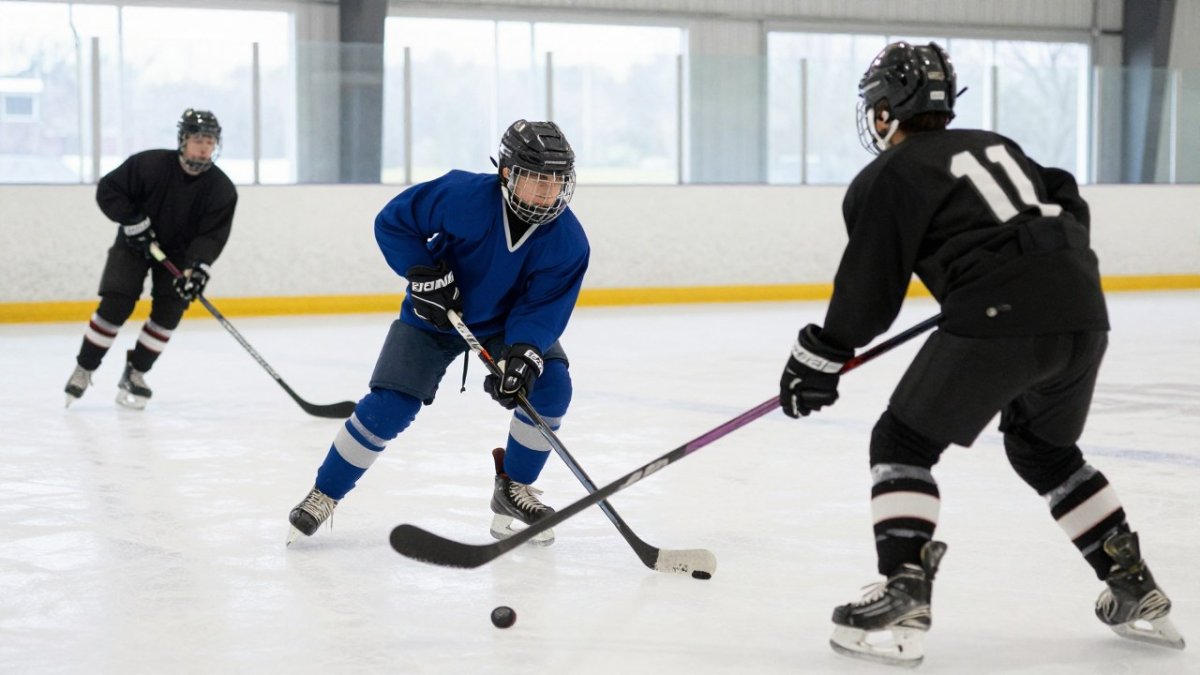
Most beginners make one of two errors. They either skate straight at the puck carrier, or they stand still and wait. Both leave the team with one option instead of several.
Use these simple rules when deciding where to go:
- Move to an open lane, not the spot right beside the puck.
- Keep one teammate on each side of the carrier when possible.
- Stay out of the defender's stick lane so a pass can still get through.
Low Support and Positioning Below the Puck
Low support means positioning yourself below the puck carrier, closer to the goal line. It gives the carrier a safe option when the defense closes in from the top of the zone. A low player can also collect a pass after a cycle and create a quick shot.
Think of low support as a safety valve. If the carrier is pressured near the boards, a teammate low in the zone can take the puck back and reset the attack.
Watch out: players who drop too deep lose the chance to shoot or make a play from the slot. Low support works best when a teammate stays high or in the middle to keep the defense honest.
Maintaining Passing Triangles and Support Spacing
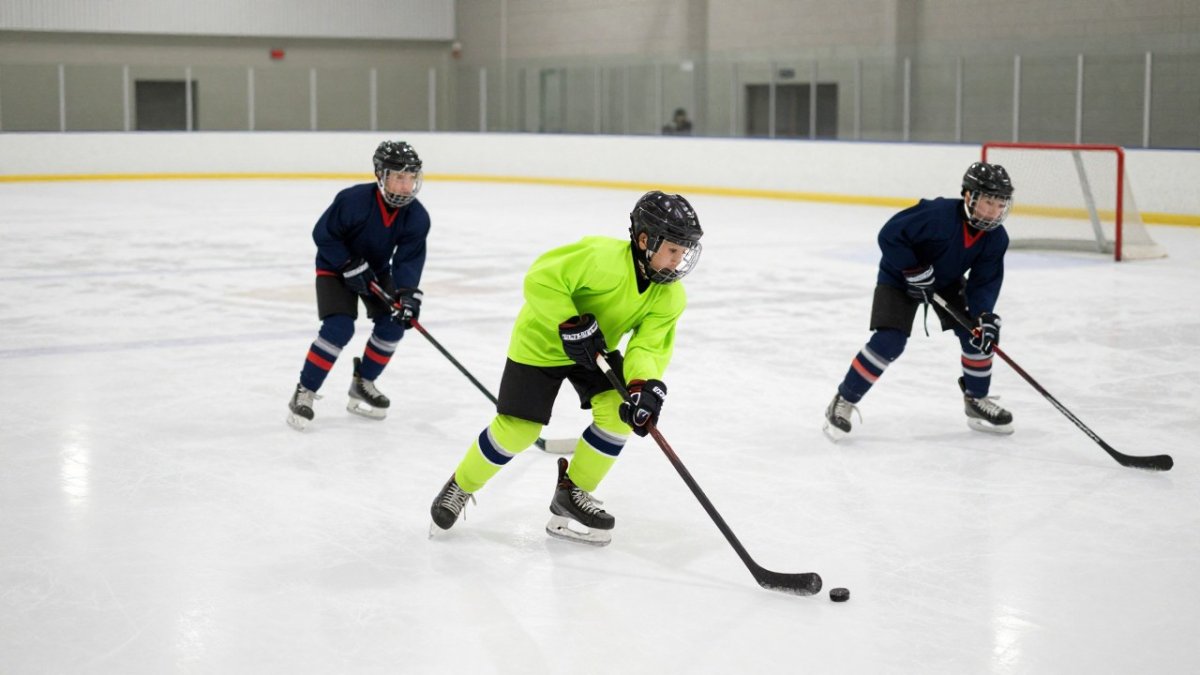
A passing triangle is three players positioned so each one can pass to the others. Triangles work because they create a shape the defense must cover. When one passing lane closes, another opens.
Keep your spacing roughly equal to a comfortable pass. If players are too close, one defender can block two lanes. If they are too far apart, passes take too long and get intercepted.
Hockey Positioning™ lets young players see these triangles as they form on the ice, which makes the spacing easier to copy in real games. You can see how the positioning layouts look on the ice to understand the basic shapes before practicing them.
Creating Passing Options for the Puck Carrier
The purpose of all puck support is to give the carrier good choices. A strong offensive zone attack always has at least two open passing options, and ideally three.
Ask yourself these questions when you are the carrier:
- Who is open right now?
- Who will be open in one second?
- Is there a shot from where I am standing?
Players who answer these questions quickly make better decisions.
If you want to build this habit at home, our off-ice drills for youth hockey positioning show how to practice scanning and reading space without a full rink.
Offensive Zone Passing Drills for Beginners
Drills turn the ideas above into habits. Start simple and add defenders or time limits only after the basic pattern feels natural.
- Two-player give and go: Pass to a teammate, skate to an open space, and receive the return pass. Repeat for two minutes, then switch.
- Three-player triangle: Three players stand in a triangle about 10 to 15 feet apart. Pass around the triangle without letting the puck touch the ground for one minute.
- Support call drill: The carrier calls "left" or "right" to show where they want support. The nearest player moves to that side and receives the pass.
- Pass and move to the net: After passing, skate toward the net and look for a rebound or tip-in chance.
Keep the drills short. A common mistake is running one drill too long, which tires players and stops improvement. Change the drill every few minutes.
Puck Support Drills to Practice on the Ice
Puck support drills focus on positioning rather than passing alone. These work well for players ages 8 to 13, and can be scaled up for adult beginners.
- Shadow drill: One player carries the puck while a support player shadows them at a fixed distance. The support player must stay in an open lane, not directly beside the carrier.
- Zone entry support: Players enter the offensive zone with the puck. Two teammates must move into support positions within three seconds of the entry.
- Cone-to-cone spacing: Place cones about 12 feet apart in an arc. Players skate between cones while keeping a triangle shape with teammates.
Coaches can adjust these drills for team size. Smaller groups focus more on individual spacing, while larger groups practice triangles and multiple lanes at once.
Common Beginner Mistakes and How to Correct Them
Most support problems come from a few repeated habits. Recognizing them is the first step, but correcting them takes a specific cue and a short practice rep.
Chasing the puck. New players crowd the carrier because they want to be involved. The fix is a spacing rule: stay two to three strides away from the puck and move to an open lane, not the spot right beside the carrier.
Standing still. Players wait for the puck to come to them instead of moving before the pass is needed. The fix is a movement rule: every time the puck changes sides, take two hard strides to a new support spot.
Skating into the defender. Moving straight at a defender takes away your own space and closes the passing lane. The fix is to approach at an angle that keeps you open, usually a curve that starts toward the defender and then breaks away into open ice.
Forgetting the weak side. Players focus only on the side with the puck, so the defense can collapse to one side. The fix is a role rule: one player stays on the far side of the ice at all times, even when the puck is on the opposite wall.
Arriving too early. Some beginners skate to the right spot but get there too soon, so the defender arrives with them and the lane closes. The fix is timing: arrive as the pass is made, not before.
Leaving the carrier without a safe option. When the carrier is pressured, beginners sometimes all skate away, leaving no short outlet. The fix is a support rule: when the carrier is under pressure, the nearest teammate must provide a short, safe option below the puck.
To measure whether support is improving, watch for observable indicators rather than vague impressions. Count how many passing options the carrier has at the moment of pressure, two or more is a good sign. Track how often the team maintains controlled possession after a zone entry.
Many parents ask why their child keeps chasing the puck. The habit is normal for new players, who want to be involved in every play. Practice and repetition help, and this guide explains why kids skate toward the puck and what to do about it.
For beginners who keep crowding the carrier, our step-by-step fix for stopping puck chasing covers specific cues to try on the ice.
The table below summarises the most common beginner support mistakes, their causes, and the fix the article recommends.
| Mistake | Cause | Fix |
|---|---|---|
| Chasing the puck | Wanting to be involved in every play | Stay two to three strides away and find the open dot |
| Standing still | Waiting for the puck to arrive | Take two hard strides to a new spot on every change |
| Skating into the defender | Approaching straight at the defender | Curve away and cut to open space as the pass arrives |
| Forgetting the weak side | Focusing only on the puck side | Keep one player on the far side at all times |
| Arriving too early | Getting to the spot before the pass | Wait until the carrier's head comes up, then move |
| No safe option for carrier | All players skate away under pressure | Nearest teammate offers a short outlet below the puck |
Start Your Child's Positioning Practice With Hockey Positioning™
Good puck support is a skill that improves with practice and clear visual guidance. Hockey Positioning™ is an interactive app that shows young players and adult beginners where to be on the ice, from power plays to penalty kills, with pro coaching tips at every puck location. For current pricing, see the Hockey Positioning™ website.
Start with one drill this week. Pick the triangle drill, run it for five minutes, and watch how your player's spacing changes. Then download Hockey Positioning™ and try the same ideas on the interactive ice surface.
Download on the App Store
Frequently Asked Questions
What does puck support mean in hockey?
Puck support means positioning yourself near the puck carrier so you can receive a pass, take over possession if the carrier is pressured, or create a second option. Support players stay in the offensive zone, keep a usable distance from the puck carrier, and move to open ice rather than standing still or chasing the puck. For beginners, the core idea is to be where your teammate can find you before they need you, and to avoid crowding the same space as the puck carrier.
How should beginners support the puck carrier in the offensive zone?
Start by staying on the side of the puck carrier that is open, usually a few strides away and slightly below the puck so you are visible and can receive a pass without turning your back to the defense. Keep your stick on the ice, call for the puck with a clear word or a stick tap when you are open, and adjust your distance as the play develops. When the carrier is pressured, move to a spot that gives them a safe outlet, such as a short pass along the boards or back toward the point.
What is the difference between puck support and puck watching?
Puck support means moving to create space and passing options for your teammate, even when you do not have the puck. Puck watching means following the puck with your eyes and body while your own position stays static or drifts toward the puck. Puck watchers tend to bunch up with teammates and leave open ice behind them. Coaches often address this by asking players to scan for open space before the puck arrives and to move before the pass is made.
What are simple offensive-zone puck-support drills for beginners?
A good starting drill is a three-player passing triangle in one half of the zone, where the puck carrier passes to one support player and moves to the other side of the triangle after each pass. Another is a two-on-zero drill where the support player must move into a passing lane before receiving the puck. Run each drill at slow speed first, then increase pace as spacing becomes automatic. Keep sessions short and focus on one cue, such as staying a stick length outside the carrier, at a time.