 blog
Best Ways to Learn Hockey Strategy: A Practical Guide
Last Updated: November 13, 2026
Quick Summary
The best way to learn hockey strategy is to watch games with purpose before memorising systems: run a focused 20-minute viewing session, pause and predict plays, and rewind every turnover. Then study one formation at a time and test it in practice.
- A focused 20-minute viewing session beats a passive full game every time.
- Pause before passes and name where the puck is going before you hit play.
- Write down three specific observations per session, no more.
- Learn one system at a time and only add the next when you can spot it without thinking.
- Read one book chapter per week and find that concept in a real broadcast.
Table of Contents
- Why Learning Hockey Strategy Starts With Watching, Not Memorising
- Hockey Strategy for Beginners: Building a Progressive Learning Path
- Hockey Strategy Videos: How to Study Games Like a Coach
- Ice Hockey Formations: The Systems Every Player Should Recognise
- Hockey Strategy Books: What to Read and How to Use Them
- How Tactics Change by Position, Score, and Game Situation
- Start Building Your Child's Hockey Sense With Interactive Positioning Practice
- Frequently Asked Questions
Why Learning Hockey Strategy Starts With Watching, Not Memorising
The best ways to learn hockey strategy rarely start with a playbook. They start with your eyes on the ice.
Watching teaches anticipation. Memorising teaches recitation. A player who can predict where the puck is going will always beat one who knows a diagram by heart but freezes on the ice.
So before you buy a single book or download a drill app, learn to watch. The sections below show you how, in order, from first viewing to full positional practice.
Hockey Strategy for Beginners: Building a Progressive Learning Path
Hockey strategy for beginners works best as a ladder, not a leap. Start with one concept at a time, and only add the next rung once the first feels automatic.
Here is the progression we recommend:
- Watch one zone at a time. Track only the defensive zone for a full period.
- Learn five positions cold. Know each player role without thinking.
- Study one system. Pick forechecking or the breakout, not both.
- Add special teams. Power play and penalty kill come after even strength.
- Test in practice. Ask your coach one question about what you studied.
A common mistake is jumping straight to power-play setups. Beginners drown in detail. Start with fundamentals: skating, passing, and where to stand.
If you are building a foundation from scratch, our beginner's guide to positional play is the natural next step.
Hockey Strategy Videos: How to Study Games Like a Coach
Hockey strategy videos are a valuable free resource in the sport, but only if you watch them the way a coach does: paused, rewound, and questioned. Watching more games is only useful with a repeatable routine.
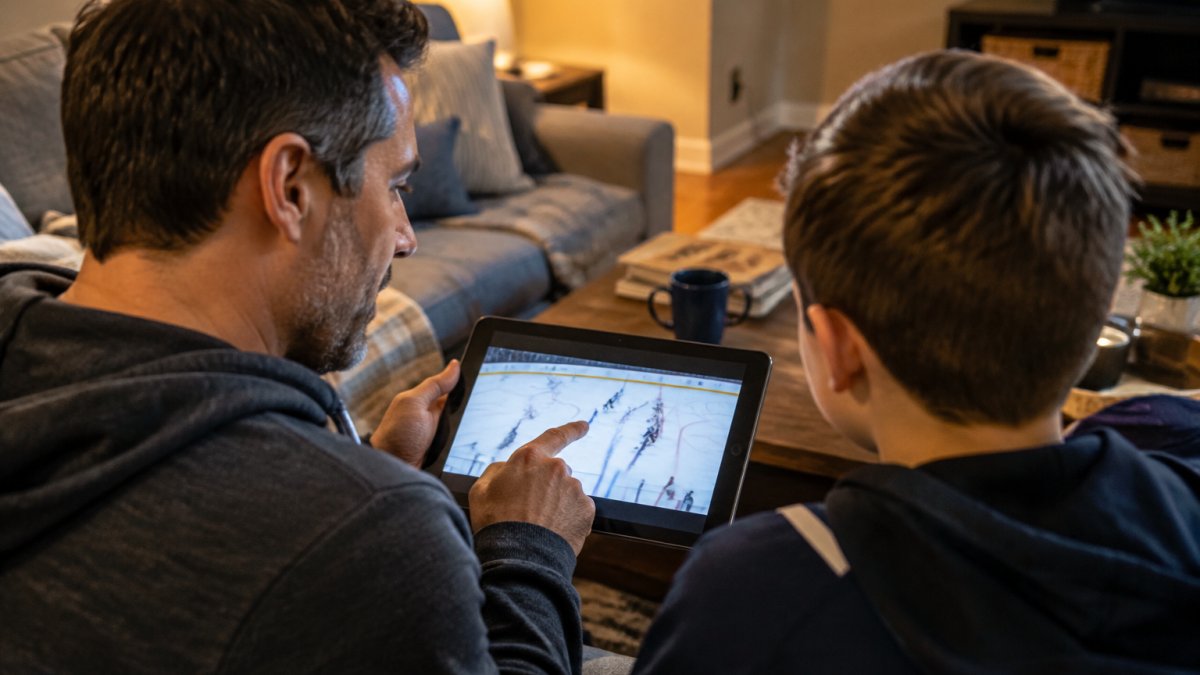
The 20-minute guided viewing session
You do not need to watch a full 60-minute game to learn. A focused 20-minute session beats a passive full game every time. Run this loop:
- Pick one lens before you press play. Choose a single thing to track for the whole session: the weak-side winger, the first defenseman back, or the puck carrier's first option. Do not track everything.
- Pause before the pass. When the puck carrier lifts their head, pause. Say out loud where the puck is going and why. Then hit play and check.
- Rewind every turnover. Ask two questions: what did the puck carrier see, and what did they miss? Turnovers are the richest teaching moments in any broadcast.
- Follow one player for a full shift. Ignore the puck entirely. Watch where that player goes when their team does not have possession. That is where positioning lives.
- Name the position out loud. "That is the weak-side winger." "That is the high slot." Naming builds recall faster than silent watching.
- Write down three observations. No more. Three specific notes per session is plenty, and a notebook of 30 observations over a month is a real scouting report on your own understanding.
A pause-and-predict drill you can run tonight
This is the exercise most video guides skip, and it is the one that builds anticipation. During any broadcast, pause the game at these five moments and predict what happens next before you hit play:
- Before a breakout pass: which side does the defenseman outlet to, and who is the support forward?
- Before a forecheck entry: does the first forechecker steer the puck carrier to the wall or to the middle?
- Before a power-play entry: does the carrier drop the puck back, carry it in, or dump it?
- Before a defensive-zone faceoff: does the defending team set up man-on-man or in a collapse?
- Before a late-game shift: does the trailing team press higher or stay structured?
Score yourself honestly. Track your hit rate in the notebook. That number is your progress meter.
How to break down a single clip
When you find a clip worth studying, slow it down and answer four questions in order:
- What was the pre-puck situation? Score, time, zone, and line on the ice.
- What shape did each team form? Name the forecheck and the defensive coverage.
- What was the first decision? Pass, carry, dump, or shot, and why.
- What was the consequence? A clean entry, a turnover, a scoring chance, or a regroup.
This four-question frame turns any highlight into a lesson. It also trains you to see the game in sequences rather than isolated plays, which is how coaches actually evaluate shifts.
Watch out: passive watching feels productive because it is comfortable. If you finish a session and cannot name three specific things you saw, you watched television, not hockey.
For app options that help you study game flow visually, see our roundup of the best hockey apps for learning game flow.
Ice Hockey Formations: The Systems Every Player Should Recognise
Ice hockey formations are the shapes teams make on purpose. You do not need to master all of them, but you should recognise the core systems, understand when each one works, and know what it gives up. A formation is a bet: every system trades one risk for another. Learn the trade-off, not just the shape.
| System | What It Looks Like | When It Works | What It Gives Up |
|---|---|---|---|
| 1-2-2 forecheck | One forechecker, two support, two back | Protecting a lead; slowing a fast transition team | Less pressure on the puck carrier; easy clean exits for a patient team |
| 2-1-2 forecheck | Two chase, one supports, two high | Chasing a goal; forcing turnovers in the offensive zone | Weak-side exposure; odd-man rushes against if the first two miss |
| 1-3-1 neutral zone | One high, three across the middle | Clogging the neutral zone; forcing dump-ins | Concedes the blue line if the first layer is beaten; passive look |
| Collapse defence | Players pack the slot | Blocking shots; protecting a one-goal lead late | Gives up the point; allows repeated point shots and screens |
| Man-on-man defence | Each defender takes a player | Tight coverage against a skilled cycle team | Easy to screen and pick; one lost battle opens the slot |
How to recognise each system live
Recognition is a skill you can practise. Use these cues during any broadcast:
- 1-2-2 forecheck: one forward is deep, two are stacked at the top of the circles, two defensemen hold the blue line. The puck carrier has time but no clean lane.
- 2-1-2 forecheck: two forwards are already below the goal line or on the walls, one sits high in the slot, and the defensemen pinch aggressively. Expect quick turnovers and quick counterattacks.
- 1-3-1 neutral zone: one forward stands near the far blue line, three players form a horizontal line across center ice, and the defensemen stay back. The neutral zone looks crowded and entries get dumped in.
- Collapse defence: all five skaters are inside the faceoff dots, the points are open, and shots come from far out with traffic in front.
- Man-on-man defence: defenders are glued to individual forwards, often chasing them behind the net, and switches are rare.
The trade-off rule
Every system gives something up. The 2-1-2 forecheck creates offense but exposes the neutral zone. The 1-3-1 neutral zone kills entries but concedes the blue line if the first layer is beaten. The collapse blocks shots but hands the point to the opposition. When you watch a game, ask: what is this team willing to give up to get what it wants? That question is the heart of strategy.
How systems change with score and time
Formations are not fixed. A team protecting a one-goal lead in the third period will often shift from an aggressive forecheck to a 1-2-2 or a collapse.
Watch out: do not try to learn all five systems at once. Pick one, watch for it for a full period, and only add the next when you can spot it without thinking.
For a deeper look at the systems and structures behind these shapes, our guide to ice hockey systems breaks each one down.
Hockey Strategy Books: What to Read and How to Use Them
Hockey strategy books reward readers who treat them as workbooks, not novels. Read a chapter, then watch a game looking for that exact concept.
A practical approach:
- Read one chapter per week, not one book per week.
- Highlight systems, then find them in a real broadcast.
- Sketch the formations by hand. Drawing beats highlighting for memory.
- Discuss one idea with your coach or a teammate.
Many players buy books and never open them twice. The readers who improve are the ones who connect a page to a shift they watched.
How Tactics Change by Position, Score, and Game Situation
Tactics are not fixed. They shift with your player role, the score, and the clock.
By position: Forwards chase and create. Defensemen hold the line and start the breakout.
By score: A team protecting a lead collapses toward the net and protects shooting lanes.
By time: Late in a close game, expect a pulled goalie, a sixth attacker, and desperate zone entries.
Knowing these shifts is what separates players who react from players who anticipate.
Start Building Your Child's Hockey Sense With Interactive Positioning Practice
Interactive practice is where watching turns into doing. This is the step most families skip, and it is the step that makes positioning stick.
Hockey Positioning™ is an interactive mobile app for players aged 5 to 13 and adults new to the sport. Instead of static diagrams, your child drags the puck across a full interactive ice surface.
Why it works for young players:
- Pro coaching tips appear at every puck location.
- Every game scenario is covered, including special teams.
- Immersive sounds and custom jersey colors keep kids engaged.
If your child still chases the puck after two seasons, this gives them a way to rehearse positioning before it counts. For more on building youth game sense, read our guide on improving youth hockey game sense. And if you are wondering whether an app can really teach positions, we answer that in is there an app to learn hockey positions.
Learning hockey strategy takes patience, and the players who improve fastest are the ones who combine watching, reading, and hands-on practice.
Frequently Asked Questions
What is the best way to learn hockey strategy as a beginner?
Start by watching games with a purpose rather than passively. Pick one position or one system, such as the forecheck, and track it for a full period. Combine that with a beginner-friendly resource that explains formations visually. Practise what you notice in small-area drills or interactive tools that let you move players into position. This mix of watching, reading, and doing builds hockey sense faster than memorising diagrams alone.
How can watching hockey games help you understand strategy?
Watching games helps you see how systems play out in real time. Pause the broadcast to predict where players will move before the puck drops. Focus on puck support, defensive-zone coverage, and how teams transition through the neutral zone. Watching with a specific question in mind, such as how the penalty kill pressures the point, turns passive viewing into active game study that transfers to your own play.
How long does it take to learn hockey systems?
Most beginners recognise basic formations like the 1-2-2 forecheck or a standard power play within a few weeks of focused study. Applying them at game speed takes a full season of practice and viewing. Young players aged 5-13 absorb positioning concepts faster when they can see them visually and repeat them in short sessions. Consistency matters more than long study blocks.
What is the difference between hockey strategy and tactics?
Strategy is the overall plan, such as how a team wants to forecheck or set up the power play. Tactics are the smaller decisions inside that plan, like when to pinch on the blue line or how to angle a puck carrier. Learning strategy gives you the framework; learning tactics helps you react within it. Both improve with game study, video review, and guided practice.